IPPNW is a non-partisan federation of national medical groups in 56 countries, representing tens of thousands of doctors, medical students, other health workers, and concerned citizens who share the common goal of creating a more peaceful and secure world freed from the threat of nuclear annihilation and armed violence.
IPPNW is the only international medical organization dedicated to the abolition of nuclear weapons. Founded by American and Soviet physicians in 1980, IPPNW is credited with raising public awareness about the devastating effects of nuclear weapons and with persuading leaders in their respective countries and around the world that the Cold War nuclear arms race was jeopardizing the survival of the entire world. IPPNW turned what was exclusively a military and political issue into a principal health concern. IPPNW received the 1985 Nobel Peace Prize in recognition of this accomplishment.
Today, IPPNW mobilizes doctors, medical students, and concerned citizens around the world in the service of our founding mission. Our work is guided by the following values:
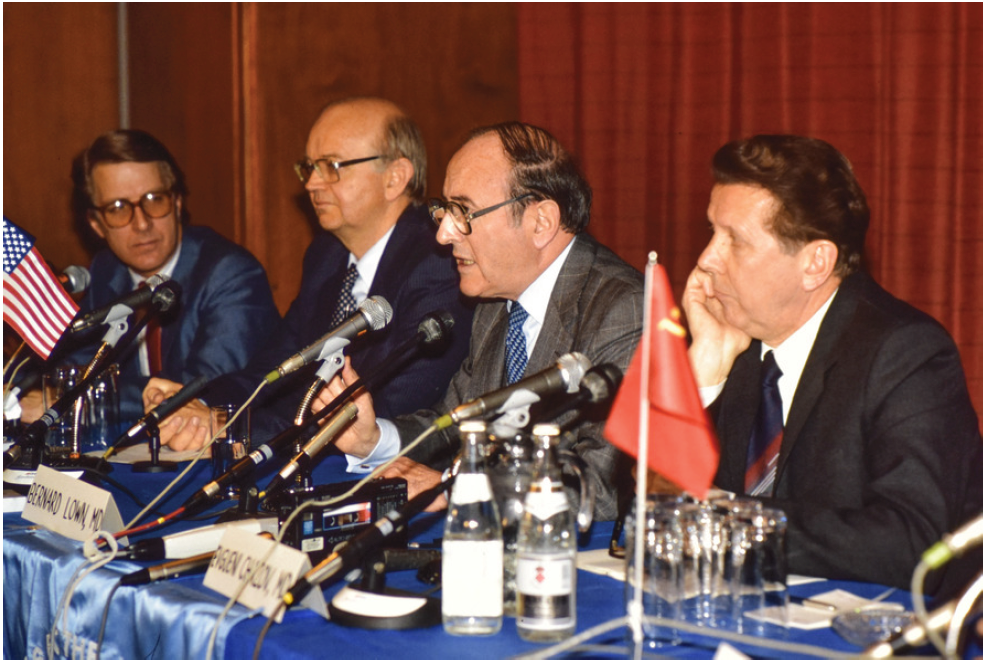
Founded in 1980, IPPNW was an inspiration born of the Cold War. With the world divided into two militarized camps poised on the brink of nuclear war, a small group of Soviet and American doctors took a leap of faith. They reasoned that their common interest in survival was more powerful than the ideological divides between them. They believed that their obligation as physicians included a common commitment to the prevention of nuclear war.
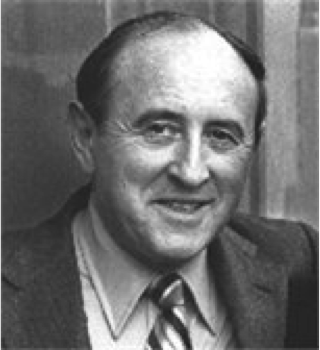
Led by co-founders Drs. Bernard Lown, Jim Muller, Eric Chivian and Herb Abrams of the US and Drs. Evgueni Chazov, Mikhail Kuzin and Leonid Ilyin of the Soviet Union, they organized a team to conduct meticulous scientific research based on data collected by Japanese colleagues who had studied the effects of the atomic bombs dropped on Hiroshima and Nagasaki. And they drew upon their knowledge of the medical effects of burn, blast, and radiation injuries.
The doctors sounded a medical warning to humanity: that nuclear war would be the final epidemic; that there would be no cure and no meaningful medical response. Their message reached millions of people around the world. In the words of former New Zealand Prime Minister David Lange, “IPPNW made medical reality a part of political reality.”
In its first five years, IPPNW, working closely with its US affiliate Physicians for Social Responsibility and IPPNW-Russia, educated health professionals, political leaders, and the public about the medical and environmental consequences of nuclear warfare. For this effort, which united physicians across the Cold War divide, IPPNW was awarded the UNESCO Peace Education Prize in 1984 and the Nobel Peace Prize in 1985.
Throughout the 1980s and the 1990s, IPPNW comprehensively documented the health and environmental effects of the production, testing, and use of nuclear weapons. In a series of well-researched, authoritative books and numerous articles and op-ed pieces in medical journals and the popular press, IPPNW spelled out the tremendous price nuclear weapons states are paying in their pursuit of nuclear weaponry.
From uranium mining to nuclear testing and production, from Nevada to Moruroa and Hanford to Chelyabinsk, IPPNW and its affiliates collected and analyzed data that provides the public with a frightening assessment of the health and environmental costs of pursuing security through nuclear weapons.
IPPNW and its affiliates not only educated the public, they also organized citizens in the nuclear states to protest and change their governments’ policies. IPPNW believes that the active involvement of millions of people is essential if we are to prevent war and abolish nuclear weapons.
Physician activists were instrumental in the campaigns to ban atmospheric and underground nuclear test explosions and in helping to shut down nuclear weapons testing sites and production facilities.
As the Cold War came to an end, IPPNW had grown to comprise some 200,000 physicians, health care workers, and concerned citizens every region of the world.
In light of growing concerns over small arms and light weapons, IPPNW launched Aiming for Prevention (AfP) at IPPNW’s international medical conference on small arms, gun violence, and injury, held in Helsinki in September 2001. The program was decentralized in 2019; however, a number of IPPNW affiliates continue to advance AfP and related initiatives.
The International Campaign to Abolish Nuclear Weapons (ICAN) was launched by IPPNW and the Medical Association of the Prevention of Nuclear War (MAPW-IPPNW Australia) in 2007 and received the Nobel Peace Prize in 2017, after campaigning successfully for the Treaty on the Prohibition of Nuclear Weapons, adopted at the United Nations in July of that year. ICAN currently comprises over 600 partner organizations in more than 100 countries. IPPNW remains a leading organization in ICAN, continuing to serve on the campaign’s International Steering Group. Read more about ICAN’s origins here.
This is not just the province of policy makers and diplomats.
For as long as humans have resorted to war to settle their differences, doctors have been expected to treat injured soldiers and civilians, and to help restore societies to health at the conclusion of armed conflict. They have a unique and profound understanding of both the immediate and the long term consequences of war. In the 1960s, a group of concerned physicians studied and documented the blast, heat, and radiation effects of nuclear weapons, and came to the inescapable conclusion that a meaningful medical response to nuclear war is impossible.
The atomic destruction of Hiroshima and Nagasaki and the lifelong suffering of the survivors-the result of only two, small, relatively primitive nuclear weapons-had put the medical profession on notice that it must prevent what it would be unable to cure. That doctors would advocate the abolition of nuclear weapons not only makes sense, it is also seen by many as a professional responsibility. The World Health Organization (with which IPPNW has had formal relations since March 1985), the US National Institute of Medicine, the British Medical Association, and the Royal Swedish Academy of Sciences are just a few of the prestigious organizations that have made major contributions to our understanding of the medical consequences of nuclear war.
IPPNW affiliates are national medical organizations with a common commitment to the abolition of nuclear weapons and the prevention of war and armed violence. As of 2024, IPPNW has affiliates in 56 countries, ranging in size from a handful of dedicated physicians and medical students to tens of thousands of activists and their supporters. As independent organizations within a global federation, IPPNW affiliates engage in a wide variety of activities related to war, health, social justice, and the environment. Their common bond, however, is a determination to rid the world of the most immediate and irreparable threat to life on Earth-nuclear weapons and nuclear war.
An International Council, comprising delegates from each IPPNW affiliate, elects IPPNW’s Board of Directors and meets regularly to discuss IPPNW’s policies and priorities. The Board of Directors is the governing body of IPPNW, responsible for the organization’s budget, staff, and programs. An Executive Committee of the Board manages ongoing governance and staff operations between Board meetings.
IPPNW’s work is coordinated by a dedicated staff team based at our Headquarters in Boston, Massachusetts and our satellite office in Geneva, Switzerland.
As an international federation of health professionals, the International Physicians for the Prevention of Nuclear War (IPPNW) is committed to creating and maintaining a safe, respectful, and professional environment at every level of our organization. Safeguarding encompasses the policies and practices that IPPNW undertakes to prevent interpersonal and organizational harm to people — especially women, medical students and young doctors, interns and volunteers, and individuals from low-income countries who are particularly vulnerable to abuse and other forms of exploitation — while in the conduct of IPPNW-affiliated activities. IPPNW is committed to preventing, responding to, and protecting its staff and members from all forms of abuse while participating in IPPNW. Harassment, exploitation, discrimination, coercion, or verbal or physical mistreatment of others will not be tolerated in IPPNW.
Review our Safeguarding Policies and Code of Conduct.