
Profile from Helix MagazineNobel Prize Perspective The Past is
Ever PresentThe profile of a Nobel Prize-winning scientist
is a regular feature in Helix. In this edition we switch the focus to prizes for
peace, profiling International Physicians for the Prevention of Nuclear War, awarded
the Nobel Peace Prize in 1985. By Nuala Moran, Freelance
Reporter, Cheshire, UK The fall of the Berlin Wall and
the subsequent end of the Cold War might have been an appropriate moment for anti-nuclear
war protesters to savour some quiet relief, hang up their banners and go into
retirement. For the doctors' pressure group International Physicians for the Prevention
of Nuclear War (IPPNW) there was the added satisfaction of knowing that its persuasive
lobbying had a direct influence on the Russian President Mikhail Gorbachev, one
of the prime movers in the termination of the Cold War. The
IPPNW won the Nobel Peace Prize in 1985 for its work to end the threat of nuclear
war, and with the truce between the us and Russia, the organization would have
been entitled to believe that the time had come to rest on its laurels. It is
fortunate for us that this prestigious group did not do so. Nine years on the
mood of optimism has soured, and the IPPNW continues its campaigning in a world
where the nuclear threat is as great as ever. There are,
of course, countless pressure groups that had in the past, and are now, campaigning
against nuclear war. What made IPPNW stand out in the eyes of the Nobel committee?
What is the rationale for an anti-nuclear organization to be composed only of
physicians? And would IPPNW not be more influential if it opened its membership
to anyone prepared to campaign against weapons of mass destruction? As
Mary Wynne Ashford, Co-President, expressed it in her address to the IPPNW's 14th
World Congress, in Paris last June, "We are not a group of activists who happen
to be doctors: we are doctors first, committed to easing suffering and death.
We bring that commitment to the global stage in our attempt to prevent the ultimate
suffering and death of nuclear war." As a grouping of physicians, IPPNW is able
to drive one point home more forcefully than any other anti-nuclear pressure group;
there is no meaningful medical response to a nuclear war, making it the greatest
threat there is to the health of everyone. It follows that prevention is the only
rational course. As doctors, the members of IPPNW believe they have a special
responsibility to ensure that governments and the public understand the horrific
nature of the threat. That the horror is not limited to the vast scale of the
immediate death and injury, but will reverberate, as radiation-driven mutagenesis
devastates future generations. A great strength of the
IPPNW is that from its formation in 1980, it has bridged political and ideological
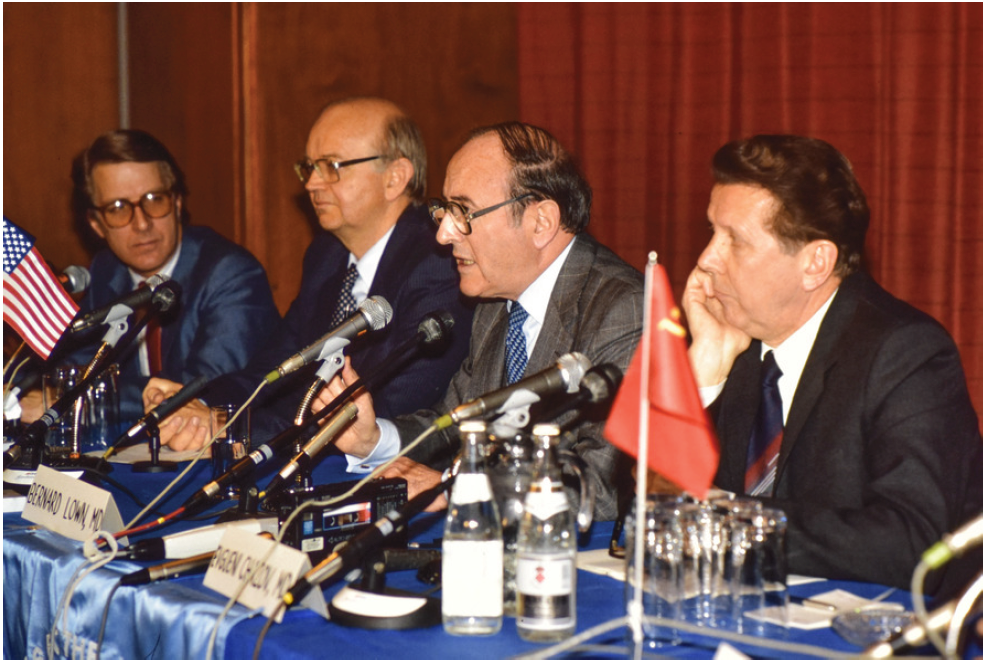
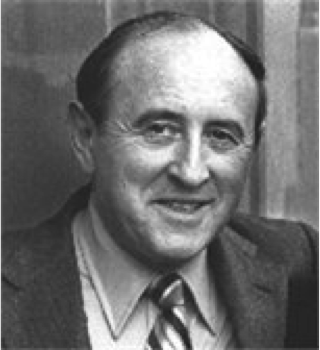
divides. The founders, Professor Bernard Lown of the Harvard School of Public
Health and Dr Yevgeny Chazov, of the ussr Cardiological Institute, united the
medical profession across the divide of the Cold War. The founders obviously caught
the prevailing mood: within five years (and before the ease of Internet communication)
IPPNW had 145,000 members in 40 countries. Not only did IPPNW encapsulate the
fears of physicians worldwide, it organized and marshalled this collective disquiet
so forcefully that in 1985 the movement was awarded the Nobel Peace Prize. In
terms of Alfred Nobel's will, the Peace Prize is awarded to the individual or
group which has "done the most or the best work for fraternity between nations,
for the abolition or reduction of standing armies and for the holding and promotion
of peace congresses." IPPNW was honoured for its important contribution to activating
opposition and mobilizing opinion against nuclear arms. Awarding
the prize on 10 December 1985, Egil Aarvik, chairman of the Norwegian Nobel Committee,
noted that the prevention of an outbreak of nuclear war was increasingly regarded
as a question of life or death for the human race. In short, "We have the choice
between living together or ceasing to live at all." "These
physicians have told us what will happen if these weapons were to be used. We
know now about the atomic winter with its destruction of the biosphere and of
all conditions necessary for life." He described how the IPPNW has shown there
is no escape route, no feasible protection against an atomic catastrophe. "Home
defence and medical services would inevitably collapse; it would be impossible
to help the injured and dying, and survivors would be subjected to the murderous
long-term consequences." But despite his assessment of
IPPNW's contribution to the cause, in the depths of the Cold War in 1985, Aarvik
was very discouraging about the likelihood of any reductions in nuclear arsenals.
He pointed out that "innumerable" disarmament conferences had produced little
results. "Possibly," he told the audience, "all we can hope for now is a stronger
mobilization of public opinion, and a corresponding strengthening of pressure
on the political authorities." For such public pressure
to be effective it has to be independent of ideology, politics and geography.
By setting it up as a non-partisan, neutral organization, with members on both
sides of the Cold War debate, the founders placed IPPNW in a unique position to
get across the global message: All humanity faces an equal threat; there can be
no victors of a nuclear war. As the Russian President Nikita
Kruschev put it, "No one will be able to see the difference between capitalist
and communist ashes." Ending the Cold War IPPNW
used the prestige conferred by winning the Nobel Peace Prize to redouble its efforts,
amongst other strategies, sending annual delegations to decision-makers in nuclear
weapons states. President Gorbachev, architect of perestroika and a prime mover
in the détente that ended the Cold War, acknowledged the extent of IPPNW's influence
in his memoir, Perestroika. "It is impossible to ignore what these people are
saying. What they are doing commands great respect. For what they say and what
they do is prompted by accurate knowledge and a passionate desire to warn humanity
about the danger looming over it." "In the light of their
arguments and the strictly scientific data which they possess, there seems no
room left for politicking. And no serious politician has the right to disregard
their conclusions." Perestroika was followed by the breakup
of the Soviet Union and the fall of Warsaw Pact governments across eastern Europe.
In the early 1990s, for the first time in four decades, the threat of all-out
nuclear war receded. A New Mandate But
the impact of so-called conventional war on human health remained as potent as
ever. In 1993 IPPNW expanded its mandate to read, "IPPNW seeks to prevent all
wars, to promote nonviolent conflict resolution, and to minimize the effects of
war and preparations for war on health, development and the environment." Changes
in military strategy have resulted in increasing the proportion of civilian deaths,
so that civilians now make up 95 per cent of the deaths in war. At the same time,
the tactic of targeting infrastructure cuts off water, electricity and fuel supplies,
destroys sewage systems, agriculture, and food distribution networks, threatening
survivors with starvation and disease. As Professor Lown noted in 1988, "Premature
death, disease, hunger, illiteracy and hopelessness everywhere on earth are the
direct consequence of the militarization of social priorities." "Development
and disarmament are indissolubly linked. One cannot achieve the former without
achieving the latter." Although the principle focus remains the abolition of nuclear
weapons, IPPNW is also working towards the broader goals of peace and health.
As a result it has involved itself in other causes such as the International Campaign
to Ban Landmines, the Jubilee 2000 Debt Eradication Campaign which aims to eliminate
the debts developing countries owe to developed countries, and the International
Action Network on Small Arms. IPPNW began campaigning
against land mines which it describes as "weapons of mass destruction in slow
motion" at the end of the Cold War in 1992. The scale of the problem is enormous.
It is estimated that there are 100 million mines spread across the land masses
of 64 countries. The worst affected countries are Afghanistan with 10 million;
Angola 15 million; Bosnia six million; Cambodia 10 million; Croatia six million;
Kurdistan 10 million; Mozambique three million; Vietnam 3.5 million. Between 25
to 30 people per day are killed by mines, and 40 maimed. Most are civilians. A
single mine costs about 3.3 euros to buy. To find and clear it costs around 334
to 1100 euros. Mines are expensive and tedious to clear but the alternative
is that they are detonated 'limb by limb'. The United Nations estimates that at
the current rate of progress, it will cost over 35 billion euros and take 1000
years to clear all the mines currently in the ground. IPPNW
is working with the International Campaign to Ban Landmines, a body which was
itself awarded the Nobel Peace Prize in 1997. Through its wide-flung membership,
IPPNW has developed the land mines campaign in Russia and the former states of
the Soviet Union and in Africa. It is also publishing a book, 'The Primary Care
of Landmines Injuries in Africa' in an attempt to improve treatment for casualties,
who are often in remote areas where the appropriate surgical skills are unavailable. Although
the problem of mines that have already been planted seems intractable, it is hoped
the 1997 international 'Treaty to Ban Antipersonnel Mines' will reduce their use
in the future. Similarly, small arms claimed three million lives in wars between
1990 and 2000. The IPPNW has given itself the mission of informing the medical
community about the small arms epidemic and the injuries they cause, as a member
of the International Action Network on Small Arms. "Weapons
violence has reached epidemic proportions in many countries from poor to rich,"
says Michael Christ, IPPNW's Executive Director. A preventative approach is necessary
to address the root causes of weapons distribution and violence in society. IPPNW
is also working for the elimination of foreign debt, owed by developing nations
to rich creditors, including many governments, in developed countries. "Debt is
a health problem," says IPPNW. The debt burden on many countries is a major cause
of poverty, and poverty is known to be a key determinant of poor health. Furthermore,
IPPNW believes that debt is linked to nuclear arms. The burden of debt is "perpetuated
through the global political, military and cultural dominance of the beneficiaries
of the debt the rich states of the world and this dominance is backed by
conventional and ultimately nuclear weapons." The Threat
of Nuclear War Re-emerges As the new millennium dawned,
the euphoria of the early 1990s gave way to a more sober appraisal. While the
size of nuclear weapons arsenals peaked in the 1980s, there remain approximately
30,000 warheads today. Some 5000 of these weapons are on hair-trigger alert, ready
to be launched at a few moments notice. Even if all existing arms control treaties
are fully implemented, there will still be 20,000 warheads in 2003. As the IPPNW's
Co-Presidents, Ashford, Sergei Gratchev and Ronald S. McCoy, put it in IPPNW's
1999 Annual Report, "We remain poised perilously close to the nuclear abyss." In
particular, India and Pakistan now have nuclear bombs; more and more countries,
including Iran and North Korea, have the missile technology to deliver nuclear
weapons; and in October 1999 the us Senate voted down the Comprehensive Test Ban
Treaty. The world is awash with plutonium, and military and economic disarray
in Russia make it more dependent than ever on nuclear weapons as conventional
forces deteriorate. In the face of these threats, IPPNW
is going, 'Back to Basics,' with a renewal of the orga-nizing and educational
efforts that brought it to prominence in the 1980s. "As the euphoric domestic
response to nuclear tests in India and Pakistan proved, there is much to be done
to educate both the medical profession, government leaders, and the public about
the medical and environmental consequences of nuclear war." IPPNW
is also stepping up its efforts to secure acceptance of a model Nuclear Weapons
Convention (nwc). Drafted by IPPNW, nwc is a highly detailed road map, which takes
the elusive goal of abolition and provides a route to achieving it. Nwc was officially
submitted to the United Nations by the government of Costa Rica, and has become
a rallying point for the nuclear abolition movement. At the beginning of this
year, a new front opened in the campaign for nuclear disarmament, with the announcement
by the George W. Bush administration, that the us is to go ahead with the us National
Missile Defense Program, or son of Star Wars. According to the us Secretary of
Defense Donald Rumsfeld, the aim is to create a defensive shield to knock down
any missile fired at us targets. But IPPNW takes an opposite
view. Ashford says it will "reverse the progress made in decades of disarmament
agreements, by undermining the abm [Anti Ballistic Missile] Treaty and by stimulating
a new arms race." "The world is at a fork in the road.
If we allow the us missile defense system, we cannot achieve the elimination of
nuclear weapons. Either we go in the direction of missile defence and a new arms
race, or we go in the direction of de-alerting and eliminating nuclear weapons.
We cannot go both ways." As it renews its efforts to eliminate
nuclear arms, the IPPNW intends to take the argument over the Missile Defence
System directly to the us government. It will challenge the assumptions underlying
this programme at its 15th Congress to be held in May this year in Washington
DC. In all of its campaigns, IPPNW is sticking to its original
principle to make the medical reality of nuclear war part of the reality of
nuclear policy making. And its basic premise that only an informed public can
effectively be organized to oppose nuclear arms is as true today as it was
when IPPNW was awarded the Nobel Peace Prize, in the pessimistic depths of the
Cold War. Despite renewed and emerging nuclear threats,
IPPNW is hopeful. "We remain optimists, because we are physicians. We believe
in healing, both at an individual and societal level." |