

Militarism, the climate crisis, and planetary health are deeply interconnected. As physicians and health workers, we warn that the climate crisis, militarisation, and nuclear weapons pose an acute threat to human and environmental health.
In the words of Dr. Tedros Ghebreyesus, the WHO Director-General, “there cannot be health without peace, and there cannot be peace without health”.
The climate crisis is already harming health through more frequent extreme weather events, food system disruption, the spread of zoonotic and infectious diseases, and worsening mental health. As a threat multiplier, it erodes the social determinants of health and deepens the root causes of conflict and instability.
Climate solutions must address inequalities. At the same time, the existence and potential use of nuclear weapons continue to pose an existential threat to all life on Earth. Enormous health benefits can be by overcoming our “fossil-fuel addiction” and rejecting militarised approaches to power.
IPPNW Engagement
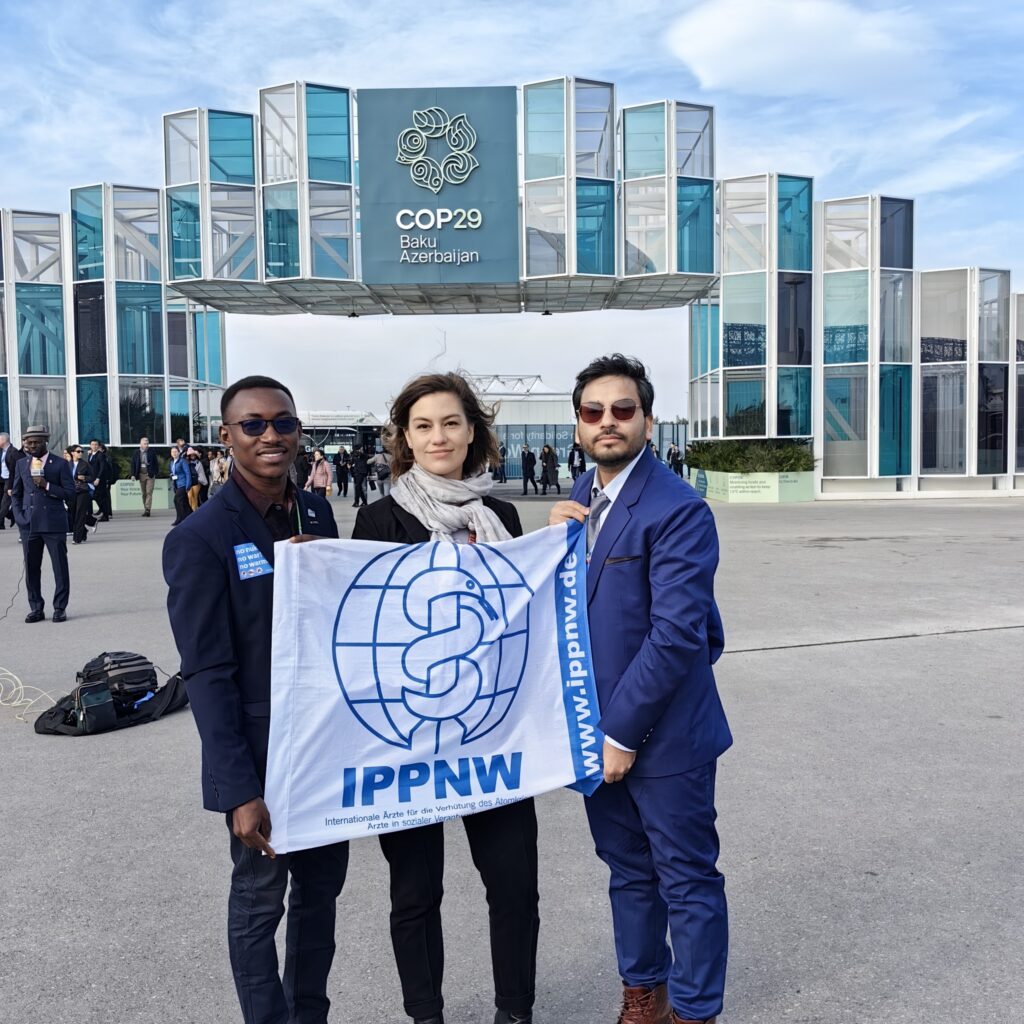
IPPNW has been recognized as an observer organisation under the United Nations Framework Convention on Climate Change (UNFCCC) since 2023. Our delegations participated in COP28 in Dubai, COP29 in Baku, and will be present at the SB62 sessions in Bonn. We bring the vital perspective of human and environmental health to the table.
The international IPPNW Working Group on the Climate Emergency convenes monthly, connecting health professionals from across continents to share expertise, exchange insights, and collaborate on joint projects.
“The COPs provide an opportunity to build a strong medical and public voice against the twin existential threats of nuclear war and the climate crisis. We must continue weaving the threads with collaborative action to raise public awareness on disarmament, climate justice and health.”
Read more about IPPNW’s participation at COP29 here.
1. Military greenhouse gas emissions accelerate climate breakdown, posing a severe threat to health and the climate. They should be included under the binding reporting to the UNFCC and reduced through demilitarisation to meet the 1.5°C target.
2. The global arms race costs immense resources and threatens human and planetary health. Disarmament and demilitarisation can help finance climate action. Cooperation and human security should be at the center of politics and decision-making.
3. Nuclear power is no solution to climate change. It has serious health consequences during its life cycle and increases the risk of nuclear weapons proliferation. Cease the creation of new nuclear power plants, enact the rapid phase-out of nuclear energy generation, and shift to a just renewable energy transition.
4. Nuclear weapons pose an acute health threat to the planet and all its life forms. Climate agreements should urge that all governments join the UN Treaty on the Prohibition of Nuclear Weapons at the earliest possible date.
1. Militarisation and an on-going global arms race are exacerbating the climate catastrophe
Military activity is estimated to contribute 5.5 % of global greenhouse gas emissions as compared to 4.4% of the global health care sector, albeit the purpose of one is killing and destruction whereas the other is set to sustain life. Yet military emissions reporting remains voluntary under the UNFCCC and the official country data remains scarce. Studies increasingly show the impact of military carbon emissions, i.e. the Pentagon was responsible for more carbon emissions in 2017 than countries such as Sweden or Denmark. The climate and environmental effects of wars are even less accounted for. Researchers found that the first 3 years of war in Ukraine accounted for 230 million tons of CO2, as much as the countries of Austria, Hungary, Czechia, and Slovakia combined in one year. While militaries and defence actors draft climate strategies, there is no evidence that a “greening” of the military is possible. Even if it were, the production and duration cycles of military equipment far outrun the closing window for climate action. The F-35 fighter jet for example produces 28 t CO2e on one tank of gas, equivalent to the annual average CO2 footprint of 4 German citizens or 70 Kenyan citizens. The F-35 is planned to be a cornerstone of NATO and U.S.-allied air power and to operate until 2070.
We need to cut emissions by half by 2030 to stay within the 1.5 degree limit and thereby ensure planetary and human health. We need to tackle military emissions.
2. Global military spending is higher than ever, diverting resources from climate action
In 2024 world military expenditure rose to $2718 billion, $91.3 billion were spent on nuclear weapons alone. Tackling the climate catastrophe will require finance for mitigation, adaptation and loss & damage. At COP29, the climate finance goal was passed. Developed countries are now required to provide $300 billion annually by 2030, a sum that falls pitifully short of the estimated climate finance needs of $2.7 trillion annually.
The last IPCC report stated clearly that fiscal space may need to stem from other sources and that “moderate reductions in military spending (which may involve conflict resolution and cross-country agreements on arms limitations) could free up considerable resources for the SDG agenda”. A report by several NGOs including IPPNW Germany found that the $1.26 trillion of NATO’s military spending in 2023 would cover African countries’ climate adaptation and mitigation for 4 years. The 9.4% increase in global military spending from 2023 to 2024 alone could cover the lion’s share of the new annual climate finance goal of $300 billion. Instead militaries and the arms industry are using climate change as an argument to increase military budgets and capacities. Arms are being exported to countries that are climate-vulnerable and that are experiencing violent conflict, thereby exacerbating the double impact of violence and climate crisis.
3. Nuclear power is a dead end in the search for clean energy
In the face of the climate crisis, some are propagating a supposedly simple carbon-free way out: nuclear energy. But in fact, nuclear energy is too insignificant in a global comparison, too slow and too expensive for the rapidly needed decarbonisation and too dangerous for people and nature to be more than a distraction without any real and timely effect on climate action. On the contrary, the sheer incompatibility of large, inflexible base-load power plants with renewable energy sources makes nuclear power more of a brake than a solution. Nuclear energy’s dominant drivers still remain the nuclear weapon states. Of the 195 countries in the world, 33 currently operate nuclear power plants. More than half (57 per cent) of the electricity generated by these nuclear power plants is accounted for by just three countries: the USA, the world’s largest producer of nuclear power, followed by China and France. With Russia in fourth place in this ranking and South Korea in fifth place, these five countries alone accounted for 71 per cent of the nuclear power generated worldwide in 2021.
Nuclear power is expensive and unreliable, is losing importance relative to overall electricity production, lags behind renewables in terms of cost-effectiveness and output and is hence outdated. And nuclear power remains dangerous: Its radiotoxic consequences and health risks along the entire fuel chain, from the uranium pit to the question of final storage, remain an unresolved burden for future generations. The risk of reallocating resources from nuclear technologies to nuclear weapons development is germane as well.
4. Nuclear weapons threaten catastrophic climate change
Nuclear weapons pose an acute existential threat to human and environmental health. A so-called “limited” nuclear war would have global catastrophic climate consequences. A 2022 study by IPPNW shows that a nuclear war between India and Pakistan, both nuclear weapon states and often in conflict, using less than 3% of the world’s nuclear arsenals could kill up to every 3rd person on earth. Leaving 97% of the world’s nuclear weapons untouched, this plausible scenario would alter the world’s climate in such a way as to reduce harvest times for the staple grains on which many populations depend, leading to a global famine in the decades to follow. As a threat-multiplier, the climate crisis exacerbates conflict and increases the risk of nuclear war.
Even when nuclear weapons are not used, their maintenance and production diverts upwards of $91.3 billion dollars per year which could go to necessary investments in renewable energy, loss and damage financing, and other climate mitigation efforts. Furthermore, the production of nuclear weapons alone causes immense human and environmental harm.
The solution to the climate crisis must include nuclear disarmament.
Additional Resources:
- Nuclear weapons and our climate
- Risks and Side Effects of Militarism & War
- Climate crossfire study
- Climate in the Crosshairs
- Risks and side effects of nuclear energy report
- How nuclear power powers the bomb report
- Nuclear famine report
- Nuclear weapons and our climate report
- Disarmament for Climate Justice and Health: reflections and direction following COP28
- Addressing Militarism for Climate Action report
- Climate justice needs peace report