
About IPPNW News Events Programs Publications and Resources Affiliates Support IPPNWContactSearchFAQBlog
In This Section

Nuclear Abolition and ICAN

Physicians and Nuclear Abolition

ICAN Action Plan

Accomplishments

Abolition Publications

Physicians and Nuclear Abolition

The medical consequences of nuclear war

[Excerpts from Medicine and Nuclear War: Preventing Proliferation and Achieving Abolition, by L. Forrow, V.W.Sidel, and J.E. Slutzman. 2007.]

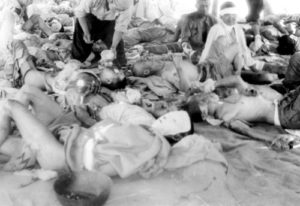
Physicians first confronted the medical consequences of the use of nuclear weapons on August 6, 1945, when surviving medical personnel struggled to care for the massive casualties in the aftermath of the Hiroshima nuclear explosion:

    Resource website to learn about nuclear weapons"In a city of two hundred and forty-five thousand, nearly a hundred thousand people had been killed or doomed at one blow; a hundred thousand more were hurt. The people . . . wept and cried, for Dr. Sasaki to hear, "Sensei! Doctor!". . . . Bewildered by the numbers, staggered by so much raw flesh, Dr. Sasaki lost all sense of profession and stopped working as a skillful surgeon and a sympathetic man; he became an automaton, mechanically wiping, daubing, winding, wiping, daubing, winding." [John Hersey. Hiroshima. Vintage Books, New York, reprinted edition, 1989.]

Many of Dr. Sasaki's patients who survived the injuries caused by heat, fire, and blast soon developed the devastating features of acute radiation sickness: severe gastrointestinal problems, uncontrolled bleeding, hair loss, and extreme susceptibility to infection. With the city's medical facilities almost entirely destroyed, effective care was virtually impossible….

The 12.5-kiloton bomb detonated in the air over Hiroshima decimated the city and created ground temperatures that reached about 7,000 degrees Celsius. Of the 76,000 buildings in the city, 92% were destroyed or damaged. There were more than 100,000 deaths and approximately 75,000 injuries among a population of nearly 250,000. Of the 298 physicians in the city, 270 were dead or injured and 1,564 of 1,780 nurses died or were injured.

The 21-kiloton bomb detonated in the air over Nagasaki three days later leveled 6.7 square kilometers (2.6 square miles). There were 75,000 immediate deaths and 75,000 injuries, with destruction of medical facilities and personnel and health consequences for the population of the city that were similar to those of Hiroshima….

The physical effects of nuclear weapons include a heat (thermal) wave, a blast wave, an electromagnetic pulse, the release of ionizing radiation, and the production of various isotopes, many of them radioactive. Specifically, the effects of a 10-to 20-kiloton nuclear weapon detonated at an altitude of 1 km include:

  • At the center of the blast (ground zero or hypocenter) the overpressures are greater than 138 kiloPascals (kPa) (20 pounds per square inch (psi)), sufficient to destroy all but the skeletons of reinforced concrete structures.
  • At approximately 1.0 km (0.6 miles) from the center of the blast, the overpressures are about 69 kPa (10 psi), sufficient to destroy all wood and brick-built structures.
  • The blast not only destroys buildings but turns bricks, lumber, furniture, cars, and people into missiles. Overpressures on the order of 3 to 14 kPa (0.5 to 2 psi), which would prevail within 1.3-2.2 km (0.8-1.4 mi) of the hypocenter of a 1-kiloton blast, will turn a window into a thousand particles of glass traveling in excess of 160 km per hour (100 mi per hour).
  • The earth below the hypocenter of the blast reaches approximately 7,000 degrees Celsius with a thermal wave transmitting up to 100 calories per square centimeter on the ground of the hypocenter and up to 2 cal/cm2 on the ground 3.5 km (2.2 mi) away. Wood is charred up to 3.0 km (1.9 mi) away, and naked skin is burned up to 3.5 km (2.2 mi) away.
  • After an initial phase of winds rushing out from the center of the blast, air rushes back vigorously, fanning the fires produced by the direct thermal radiation, creating a firestorm.
  • In a densely populated area, immediate injuries include tens of thousands of burns, with many of them third degree. These occur on top of thousands of crush injuries due to collapsed buildings and blast-induced "missile" impact on human bodies. Hospital beds and medical supplies in the immediate area will have been destroyed and personnel killed or disabled, resulting in few, if any, local medical resources being available.
  • Many victims will suffer from ruptured organs (particularly lungs), penetrating trauma (due to the objects that were turned into missiles), fractured skulls, and compound fractures, both from physical objects striking people and from people themselves having been turned into missiles until they struck any hard object.
  • A significant number of people would be deafened due to ruptured eardrums.
  • Many people would be blinded. The initial flash of light at the start of a detonation bleaches retinal pigments causing flash blindness for up to 40 minutes. Much more seriously, viewing the fireball with the naked eye can cause more permanent damage, including retinal burns and scars in the visual field.

Additionally, nuclear detonations at higher altitudes (greater than 10 km or 6.2 mi) cause the release of an electromagnetic pulse (EMP), which would affect virtually all electrical and electronic equipment within line of sight of the detonation.

Radiation exposure would result from the initial radiation flux of neutrons and gamma rays and from the fallout of the radioisotopes produced by the detonation. In the immediate area of the nuclear explosion, the extent of radiation injury will be irrelevant since people will have been killed by the direct thermal and blast effects. Radiation poses a particular problem for rescuers attempting to assess the severity of injuries since there is no way, especially in the initial period, to know whether a person has received a moderate exposure and might survive with adequate care or has received a large exposure and will die regardless of what treatment is offered.

The combinations of the diverse injuries (burns, crush injuries, ruptured organs, fractures, extensive blood loss, and radiation exposure) would multiply the likelihood that injuries would be fatal.

A 2002 study published in the British Medical Journal estimated the casualites from a 12.5 kiloton nuclear explosion at ground level near the port area of New York City. The model projected 262,000 people would be killed, including 52,000 immediately and the remainder succumbing to radiation injuries. Caring for survivors would also be difficult, if not impossible, with the loss of 1,000 hospital beds in the blast and another 8,700 available beds in areas of high radiation exposure. While an airburst would result in more physical destruction, a terrorist detonation would most likely be at ground level, generating greater radioactive fallout.

Medical consequences of nuclear war: archival resources

Please click on the download icons [ ] below.

Medicine and Nuclear War: Preventing Proliferation and Achieving Abolition, by L. Forrow, V. W. Sidel, and J. E. Slutzman. 2007.

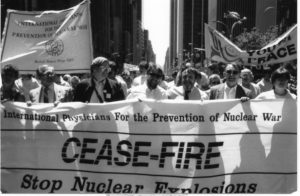
Proceedings of the First Congress of International Physicians for the Prevention of Nuclear War. Airlie, VA. 1981
. Topics covered at the first IPPNW Congress included predictable and unpredictable effects of nuclear war; the role of physicians in the post-attack period; social, economic, and psychological costs; and what physicians can do to prevent nuclear war.

Transcript of IPPNW telecast on Soviet National Television. June 24, 1982.This unprecedented roundtable discussion about the medical consequences of nuclear war was broadcast in its entirety on Soviet television and was seen by millions of Russians. US networks refused to show it to an American audience.

Excerpts from Last Aid: The Medical Dimensions of Nuclear War. Edited by Eric Chivian, Susanna Chivian, Robert Jay Lifton, John E. Mack. New York: W. H. Freeman and Co. 1982.

    Acute Medical Effects at Hiroshima and Nagasaki. Ohkita.
    Burn Injuries Among Survivors. Constable.
    Delayed Medical Effects at Hiroshima and Nagasaki. Ohkita.
    Psychological Effects of the Atomic Bombings. Lifton.
    Survivors of Nuclear War: Infection and the Spread of Disease. Abrams.
    Survivors of Nuclear War: Psychological and Communal Breakdown.
    Lifton, Erikson.

Excerpt from Plutonium: Deadly Gold of the Nuclear Age. Cambridge, MA: International Physicians Press. 1992.

    Nuclear Poison.
    Summary of plutonium's toxicity, routes of exposure, and carcinogenicity.

Excerpt from Nuclear Wastelands: A global guide to nuclear weapons production and its health and environmental effects. Edited by Arjun Makhijani, Howard Hu, and Katherine Yih. Cambridge, MA: MIT Press. 1995.

    Health risks of ionizing radiation.

The following articles have appeared in journals and IPPNW publications from 1962 to the present [chronological order].

    The Medical Consequences of Thermonuclear War. Various authors. New England Journal of Medicine, 1962. The original research papers on the medical consequences of nuclear war, published in the New England Journal of Medicine in 1962 and written by members of the Physicians for Social Responsibility Study Group, including Bernard Lown, Victor W. Seidel, and H. Jack Geiger.

    Medical Problems of Survivors of Nuclear War. Abrams, von Kaenel. New England Journal of Medicine, 1981. Discusses infection and the spread of communicable diseases.

    A Medical Prescription for Survival. Lown, Pastore. Lancet. 1985

    New Perspectives on the Medical Consequences of Nuclear War. Leaf. New England Journal of Medicine, 1986.

    The Problem of Accidental or Inadvertent Nuclear War. Abrams. Preventive Medicine. 1987.

    The Short-Term Effects of Nuclear War: The Medical Legacy of Hiroshima and Nagasaki. Pastore. Preventive Medicine. 1987.

    Psychiatric Aspects of Nuclear War. Richter. Preventive Medicine. 1987.

    Twelve Articles by Supporters of IPPNW. (1) Looking back, seeing ahead; Lown. (2) Physicians, triage, and nuclear war; Leaning. (3) Nuclear threat and health in the Pacific Ocean; Maddocks. (4) The enemy system; Mack. (5) The arms race as a threat to health; Sidel. (6) Nuclear weapons test ban 1988; McCally, Cassel. (7) Inadvertent nuclear war; Abrams. (8) Youth and the threat of nuclear war; Beardslee. (9) Could we safely negotiate a treaty banning all nuclear tests?; Leggett. (10) A view from a nation less likely to be a target of nuclear weapons. Velasquez. (11) Nuclear winter; Piemonte. (12) Medical education and nuclear war; McCally, Cassel, Norgrove. The Lancet. 1988.

    Accidental nuclear war - a post-cold war assessment. Forrow et al. New England Journal of Medicine, 1998.

    Medicine and nuclear war: From Hiroshima to mutual assured destruction to Abolition 2000. Forrow, Sidel. Journal of the American Medical Association. 1998.

For more information about the International Campaign to Abolish Nuclear Weapons (ICAN), contact John Loretz, Program Director, IPPNW, 66-70 Union Square, #204, Somerville, MA 02143; 617.440.1733, ext. 280.