 |
Nuclear Famine: Climate and health effects of regional nuclear war
In
December 2006, climate scientists who had worked with the late Carl Sagan in the
1980s to document and publicize the threat of nuclear winter produced disturbing
new research about the climate effects of low-yield, regional nuclear war. These
experts found that even a limited regional nuclear war on the order of 100 Hiroshima-sized
nuclear weapons could result in tens of millions of immediate deaths and unprecedented
global climate disruption.
To take one example, India and Pakistan currently
possess an estimated 100 nuclear weapons or more between them. A regional nuclear
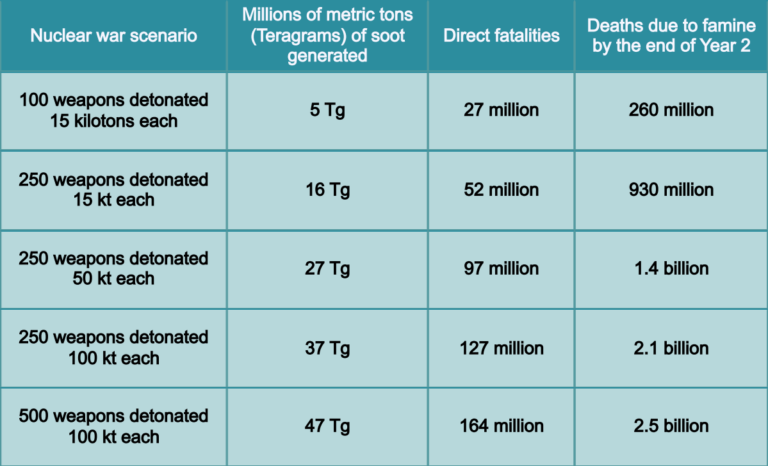
war in South Asia involving only 100 Hiroshima-sized (15-kt) weapons targeted
on megacities would kill 20 million people outright and cause tremendous public
health, environmental, and economic consequences. Yet these horrifying local and
regional effects would be dwarfed by the global climate consequences-and ensuing
casualties-of such a conflict.
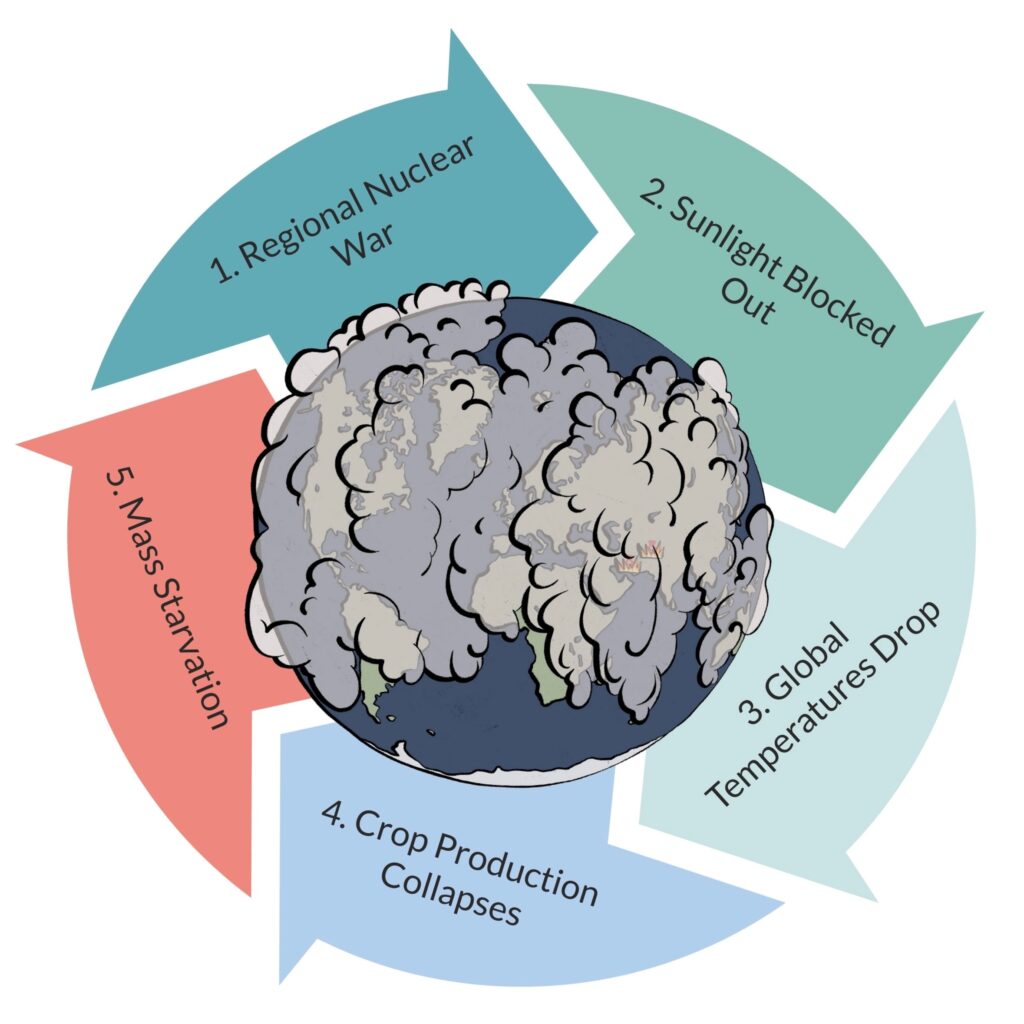
Smoke from urban firestorms caused by multiple
nuclear explosions would rise into the upper troposphere and, due to atmospheric
heating, would subsequently be boosted deep into the stratosphere. The resulting
soot cloud would block the sun, leading to significant cooling and reductions
in precipitation lasting for more than a decade. Within 10 days following the
explosions, there would be a drop in average surface temperature of 1.25°
C.
Over the following year, a 10% decline in average global rainfall and
a large reduction in the Asian summer monsoon would have a significant impact
on agricultural production. These effects would persist over many years. The growing
season would be shortened by 10 to 20 days in many of the most important grain
producing areas in the world, which might completely eliminate crops that have
insufficient time to reach maturity. Large quantities of food might also need
to be destroyed and significant areas of crop land might need to be taken out
of production because of radioactive contamination.
While it is not possible
to estimate the precise extent of the global famine that would follow a regional
nuclear war, it seems reasonable to anticipate a total global death toll in the
range of one billion from starvation alone. To make matters even worse, a huge
reduction in the Earth's protective ozone would have serious additional consequences
for human health.
These scientific findings and the health concerns drawn
from them have significant implications for nuclear weapons policy. They are powerful
evidence in the case against the proliferation of nuclear weapons and against
the continued possession and modernization of arsenals in the existing nuclear
weapon states. If even a relatively small nuclear war, by Cold War standards,
could trigger a global catastrophe, the only viable response is the complete abolition
of nuclear weapons.
As a priority of the International Campaign to Abolish
Nuclear Weapons (ICAN), IPPNW has prepared a series of resources on the climate
effects of regional nuclear war and our concerns about nuclear famine. You can
download these resources here, share them with others, and join us in our campaign
for a nuclear-weapon-free world.
ResourcesAn assessment of
the extent of projected global famine resulting from limited, regional nuclear
war; by Ira Helfand, MD
[PDF 498KB]
Nuclear
famine: Climate and health effects of regional nuclear war - An IPPNW fact sheet
[PDF 179KB]
Climate
and health effects of regional nuclear war: How sudden global cooling could produce
a "nuclear famine"
[PPT 4.4MB]
Accompanying
script for the powerpoint presentation
[PDF 112KB]
Scientific
papers and other resources about the climate effects of nuclear war can be found
here.
For
more information about the International Campaign to Abolish Nuclear Weapons (ICAN),
contact John Loretz, Program Director,
IPPNW, 727 Massachusetts Ave., Cambridge, MA 02139; 617-868-5050, ext. 280.
|  |