Aiming
for Prevention International Initiatives
Programme of Action to Prevent,
Combat and Eradicate the Illicit Trade in Small Arms and Light Weapons in All
Its Aspects - July 2001Governments in recent years have
begun various efforts to control small arms, especially as they relate to crime
and insurgency, through increased coordination of export and licensing policies,
customs controls, and police intelligence. In this vein, IPPNW participated in
the UN "Conference on the Illicit Trade in Small Arms and Light Weapons in
All Its Aspects" held in July 2001. The purpose of the conference was to
decide on steps nations should take to prevent the illicit trade in small arms.
Non-governmental organizations, under the umbrella of the
International Action Network on Small Arms (IANSA), of which IPPNW is a founding
member, along with other groups, took a prominent role in the conference, presenting
evidence on the difficulty in separating legal and illegal transfers, and calling
for tough controls on both state and non-state weapons sellers. The result of
the 2001 conference was a "Programme
of Action to Prevent, Combat and Eradicate the Illicit Trade in Small Arms and
Light Weapons in All Its Aspects." The Programme of Action includes calls
to combat the small arms trade simultanesously from both a supply and demand perspective,
and to develop and support action-oriented research. NGOs Urge Governments
to Cast a Wide Net in Controlling Small ArmsGun Violence
Is a Public Health Issue Asserts IPPNW at UN Conference in New York:
Report on IPPNW participation at the Preparatory Committee, second session for
the UN Conference on the Illicit Trade in Small Arms and Light Weapons in All
Its Aspects 8-19 January, 2001 at the UN in New YorkOverview
Governments met from 8-19 January to discuss the range of control measures that
should come out of the July 2001 UN Conference on the Illicit Trade in Small Arms
and Light Weapons in All Its Aspects. In a generally cooperative atmosphere, government
delegates suggested revisions to the draft Program of Action presented
by the conference Chairman, Ambassador dos Santos of Mozambique.
While governments debated the measures necessary for controlling illicit trade,
NGOs called for increased attention to the control of licit, or legal, trade including
aspects such as domestic gun use, commercial sales, and government-to-government
exports. Though a number of governments are sympathetic to the NGO coalition --
the International Action Network on Small Arms (IANSA) -- the draft Program fell
short of the comprehensive approach that NGOs are urging. NGO
Involvement Improves NGO access to this second
PrepCom was drastically improved over the first one a year ago. Nearly all the
official plenaries were open to observers from the public, as opposed to last
years closed sessions, and many delegations spoke positively of meaningful
NGO involvement in the process. NGOs and diplomats shared information in panel
discussions, informal briefings, and book launches held at or near the UN.
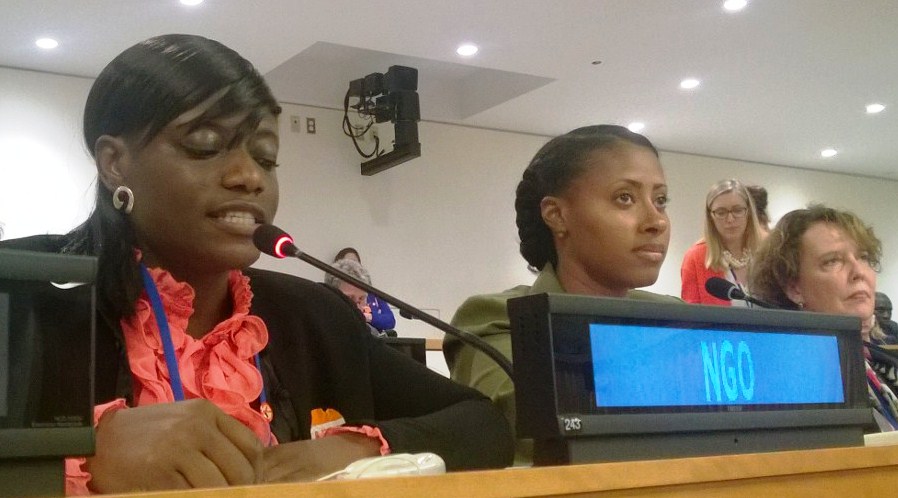
NGOs were granted a 3-hour bloc in which to present their views -- a crucial opportunity
to educate the convened delegates about NGOs and their credibility as partners
in the process of small arms control. NGOs scrambled to organize 25 5-minute presentations.
IPPNW presented a statement on the health impacts of small
arms and urged a range of controls. The presentation was drafted by staff
members Brian Rawson and Merav Datan and presented to delegates by Cathey Falvo,
MD, MPH. Despite this, the specific role for NGOs in
future official proceedings is uncertain. The conference postponed decisions about
accrediting NGOs to the future PrepCom and July conference. It is expected that
NGO access will resemble the arrangement for the NPT Review Conference of April
2000. Read the conference
report filed by former Small Arms Campaign Coordinator Brian Rawson and the
presentations made by Neil
Arya (Physicians for Global Survival, Canada) and Vyacheslav
Sharov (Russian Physicians for the Prevention of Nuclear War). IPPNWS
Role: Current and Future IPPNW
Establishes Its Role Within IANSA as Advocate for Public Health Approach
Within the small-arms-control community, IPPNW established itself as a useful
partner and an advocate for public health approaches to the small arms problem.
Delegates and NGO partners expressed interest in IPPNW and PSR-Finlands
conference Aiming for Prevention: International
Medical Conference on Small Arms, Gun Violence, and Injury, to be held
in Helsinki, September 2001. In addition, Victor W. Sidel, MD gave a brief presentation
to a delegates luncheon organized by the Hague Appeal for Peace, Cathey
Falvo presented IPPNWs statement to government delegates, and Brian Rawson
chaired an NGO panel on the health impacts of small arms.
Contact was made and relationships fostered with such health and humanitarian
organizations as WHO, UNICEF, SAFER-Net, Oxfam, the Small Arms Survey, and individual
doctors, all of whom are working on the small arms issue.
The March PrepCom and the July Conference:
Prospects for IPPNW Involvement There is a
need for groups like IPPNW to bring the medical message to the next UN meetings.
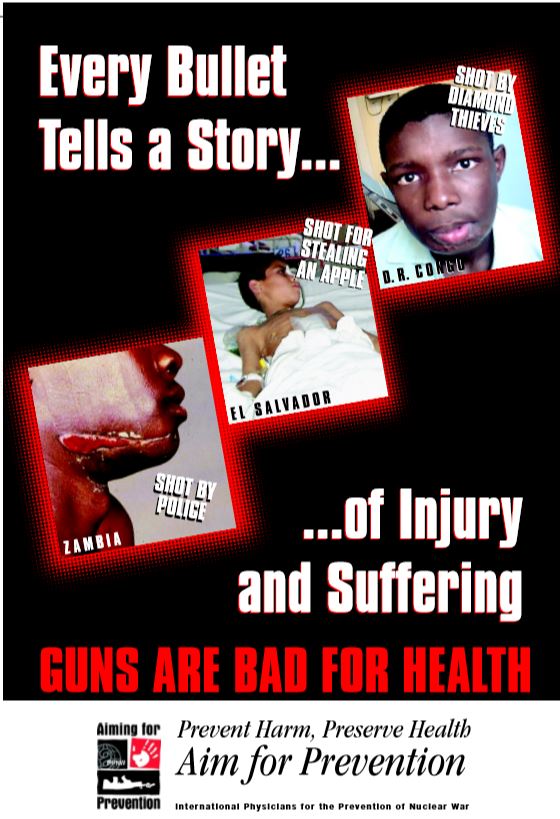
Where political will is flagging, the stark picture of human suffering will provide
motivation. NGOs have not yet emphasized this message, instead focusing on technical
policy recommendations. Testimonies from survivors, first-hand accounts from physicians,
and photographs should be delivered to the next PrepCom, from 19-30 March 2001,
and the actual conference, from 9-20 July, 2001. Both will be in New York.
Medical Report on Small Arms
IPPNW already plans to distribute a report in March, with a followup in July on
the medical effects of small arms. IPPNW will team up with SAFER-Net, a Canada-based
NGO linking health to firearms control, to produce the report. It will summarize
the latest findings of medical research and epidemiological studies on small arms,
make a case for greater involvement of the health sector in the UN Program of
Action on small arms, and give policy recommendations based on existing medical
research. Health
Concerns in Government Action Plans The UN
Program of Action should recognize the importance of the health sector, call for
its involvement, and encourage financial assistance to medical projects related
to small arms. The current draft of the Program does not include such language.
IPPNW is in contact with the WHO in regard to working with specific governments
to draft and introduce such language. Connecting
NGO Communities IPPNW should help strengthen
NGO presence at the UN conferences by bringing together different branches of
civil society concerned with arms. The health and humanitarian sector is not fully
connected with the small arms issue. Also, domestic gun control movements in the
US and other countries are not yet connected with the international movement.
This connection is important not only for political clout, but also for driving
home the message that domestic gun regulations are essential to controlling the
international illicit trade in small arms. Because of IPPNWs federation
structure, it is well positioned to make these connections. Political
Issues A brief synopsis
of some of the key debates Governments debated some
contentious issues during the recent PrepCom, and NGOs voiced their own concerns.
A number of reports, documents, and analyses are available from the IANSA
website. The website for the UN
Department of Disarmament Affairs contains additional documents.
Defining "Illicit" Trade
What constitutes illicit trade in small arms? Governments agree that
criminals and insurgents should not trade in arms, nor should countries under
a UN arms embargo. But they disagree as to whether restrictions should apply to
forms of legal trade such as commercial sales both domestic and international,
government-to-government transfers, and other grey areas such as arms brokers
(the middlemen who exploit lax regulations in certain countries to redirect arms
toward illicit buyers). NGOs argue that such legal forms of trade must be controlled.
Defining
"Small Arms" What constitutes small
arms? The current draft Program of Action applies the term small arm only
to military specification weapons. This leaves out a whole range of handguns,
firearms, police gear and sport-weapons that are not designed specifically for
military use. NGOs argue that these arms are responsible for a major portion of
small arms violence, and should be included in current negotiations.
Binding Measures or Political Commitments?
Will the UN Program of Action be an expression of political commitments or legally
binding measures? The measures in the Program will express the intentions of states,
but will most likely be non-binding. The UN deals in customary norms as much as
enforceable laws (the signs in the cafeteria say Smoking Discouraged
rather than Smoking Prohibited.) With small arms, political commitments
have had some success -- examples are the EU Code of Conduct limitations on arms
exports and the West African ECOWAS voluntary moratorium on arms imports. This
global expression of detailed norms and political commitments would be a significant
achievement, though non-binding. New
Infrastructure? Should new agencies be created
to oversee the control of illicit arms trade? Should power be centered at the
national, regional, or international level? States are wary of encroachments on
their sovereignty, and many prefer to restrict information-sharing and policy
coordination to the regional level. Some states disapprove of increasing bureaucracies.
Statement by Cathey Falvo, MD, MPH,
at the Small Arms PrepComm - 18 January, 2001
|