
About IPPNWNewsEventsProgramsPublications and ResourcesAffiliatesSupport IPPNWContactSearchFAQHome
In This Section

Nuclear Abolition and ICAN

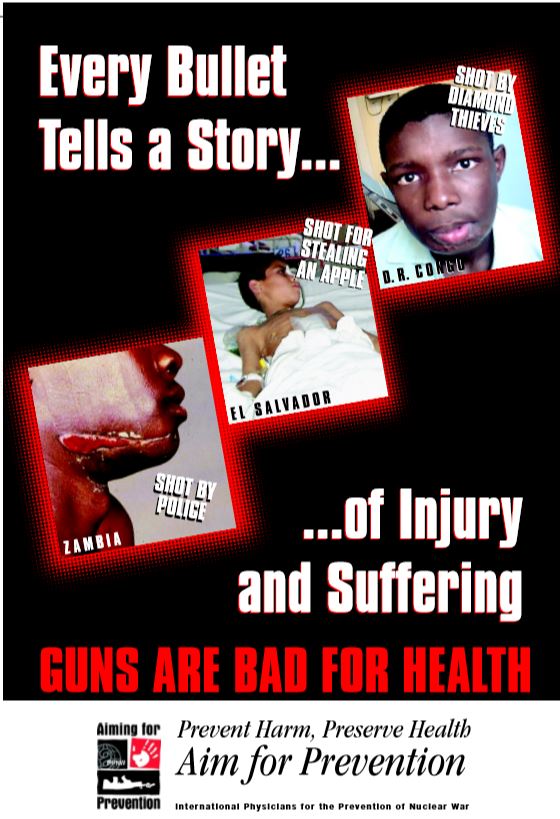
Small Arms and Aiming for Prevention

The Small Arms Threat

Affiliate Initiatives

International Initiatives

News

Publications

Links

Campaign Materials

Peace Through Health

Programs (main page)

Aiming For Prevention logoAiming for Prevention: International Medical Conference on Small Arms, Gun Violence and Injury

Executive Summary

September 28-30, 2001
Paasitorni Conference Center
Helsinki, Finland

  • The level of global small arms violence is enormous and the scale of human suffering it causes is immense though poorly counted. It causes at least hundreds of thousands of deaths and more than one million injuries each year, as well as permanent physical and psychological damage, the destruction of families, lost productivity, and the diversion of resources from basic health services.
  • Research is required on three basic issues:
    1. the health effects of weapons,
    2. the contributing factors and causes, including behavioral issues, and
    3. the impacts of interventions, and their cost effectiveness.
  • Policies and programs designed to reduce the human and social impacts of small arms should make use of public health knowledge and analysis of risk factors as a means of bringing increased focus and effectiveness to their objectives.
  • Special effort is required to collect data from "disorganized settings" - areas of extreme resource constraint and humanitarian crisis - and to help strengthen record keeping systems.
  • * Funding for public health research of small arms injury should be a priority for the donor community, with recognition of the necessity for long-term research, and a commitment to quality analysis of collected data.
  • Public health access to relevant military and police data is needed. Linked data systems should be employed combining data from medical examiners, coroners, law enforcement, and including background information about the firearm used, and the relationship between the victim and perpetrator.
  • Measures are needed to improve access to information about firearms. A standardized system of marking firearms should be established, and firearms used in cases of injury should be fully investigated as to their model, features, and origin.
  • "Supply side" and "demand side" efforts to reduce the presence of and market for lethal weapons should be pursued simultaneously. Global coordinated action on both supply and demand factors is possible.
  • To play a crucial role in establishing policy and programs on small arms to enhance health and safety, health professionals can provide credible medical research on health impacts of weapons to inform debate and critique of existing policy; support better enforcement of existing law and improved standards based on health concerns; and monitor and evaluate progress.

"Sometimes patients will come six or seven in number, and you have one operating room, and so it's difficult to prioritize because all of the injuries are severe. When they brought these patients in from a drive about four hours away after the 22 people were shot, five of those patients were under the age of five. There was one child that needed a colostomy, the child is only three years old. And you're prioritizing between a three-year-old and a six-year-old. I mean, it's ridiculous."

- Olive Kobusingye, surgeon and epidemiologist, Uganda

About the Project

Nearly 200 participants from 50 countries attended the conference "Aiming for Prevention," held in Helsinki, Finland, September 28-30, 2001, and organized by IPPNW and its Finnish affiliate, Physicians for Social Responsibility-Finland. The conference received technical support from the World Health Organization (WHO) and featured involvement of medical and health professionals, humanitarian and development workers, disarmament experts, governments and intergovernmental agencies. The conference was motivated by the following:

  • For two decades, International Physicians for the Prevention of Nuclear War has advocated for a primary prevention approach to weapons that cause massive, indiscriminate human suffering and casualties that overwhelm capacities for medical treatment. With the intensity of modern conventional weaponry and war, IPPNW's call for prevention has extended from nuclear weapons to weapons such as small arms. IPPNW views warfare as interconnected on a spectrum of violence, with smaller wars and weapons escalating unpredictably to larger ones. Thus, working to prevent war with small arms is crucial to the overarching effort of preventing nuclear war.
  • Small arms and light weapons have been recognized as a humanitarian problem and associated with the majority of recent war casualties, but the dimensions of problem are poorly understood. Attempts at the United Nations and within regions to control the problem have been slowed by politics and restricted to more traditional national security and law enforcement approaches. As noted by the International Action Network on Small Arms and the Humanitarian Coalition on Small Arms, the concept of primary prevention has been lost in such venues, along with the sense of urgency and humanitarian crisis.
  • In 1996, the assembly of the World Health Organization passed a resolution declaring violence a global public health problem, emphasizing not only its physical effects but its impact on mental health, the wider community, and scarce health resources. Since this time the WHO has worked to better understand the role of small arms in global health.

"I see this event as a milestone, I see it as the first time that the international public health community gets the opportunity to get together and talk about the way ahead."

- Etienne Krug, Director of Department for Injury and Violence Prevention, WHO

Introduction

Small arms and gun violence* is manifest in vastly different ways -- from war and mass violence to individual acts of murder and suicide. Despite this range of use, violence with small arms has common features:

  • Lethality. Small arms tend to increase the chance that an act of violence will end in a fatal outcome.
  • Medical burden. Attempts to restore the health of victims of small arms violence are challenging, time consuming, and costly.
  • Preventable. On the whole, small arms violence is preventable. Primary prevention is the most appropriate way to deal with a problem causing massive casualties worldwide.

IPPNW recognizes the diversity of the problem, and the need to tailor local interventions to meet local circumstances. At the same time, it recognizes the global connections of the networks and sources that supply the weapons and the international nature of the politics, economics, and population flows that underpin the problem.

To understand and prevent such a complex problem requires a sophisticated methodology. Prevention is a proactive undertaking that defies solution through more reactive conventional law enforcement or national security approaches. To wage a "war on gun violence" would be an oxymoron. A better metaphor, perhaps, would be a campaign to eradicate an epidemic through research, education, advocacy and immunization.

Involvement of many disciplines and social sectors will be required in preventing small arms and gun violence, but public health and medical knowledge provides a framework critical to success. A public health approach helps to dissect the entirety of the problem, objectively assess causal factors, and focus policies and programs where they are most needed and most effective. Global dialogue among health professionals is necessary to inform local efforts, and international coordination is necessary for sharing information, tools, resources, and strategies.

The conference "Aiming for Prevention" attempted to clarify, through dialogue, the tools and resources necessary to take a health approach to small arms and gun violence. The program followed a logical progression through the following categories:

  1. Knowledge and research
  2. Analysis of risk factors
  3. Prevention through advocacy and programs

The text that follows is an analytic summary of the conference. It draws upon formal presentations by panelists, comments and questions from the floor, as well as working group notes and reports.


[* During the conference, the category of "small arms" referred to those conventional arms characterized as available, affordable, easy to use and transport, and capable of causing severe, lethal injury. This conference addressed both military and civilian arms of such definition, including assault rifles, handguns, grenades, mortars, long-guns, and others.]

"... health and medical institutions... are urged, as appropriate, to develop and support action oriented research aimed at facilitating greater awareness and better understanding of the nature and scope of the problems associated with the illicit trade in small arms and light weapons in all its aspects."

- Program of Action, final document of the United Nations Conference on the Illicit Trade in Small Arms and Light Weapons in All Its Aspects, 20 July 2001

Knowledge and Research

Existing Knowledge

The level of global small arms violence and the scale of human suffering it causes is poorly counted. But it is known to cause at least hundreds of thousands of deaths and more than one million injuries each year, as well as permanent physical and psychological damage, the destruction of families, lost productivity, and the diversion of resources from basic health services. Research is required to provide useful estimates based on solid data.

Aggregate data from "organized settings"

WHO released a report "Small Arms and Global Health" in July 2001 which compiled official data from 48 countries representing about 1/5th of the world population. It showed:

  • 100,000 deaths/year from small arms and gun violence.
  • In high income countries most firearms deaths are suicides (about 70%), and in middle and low income countries most are homicides (about 75% and 90%, respectively). The US and Brazil both have aberrantly high rates of homicide.
  • Small arms are the leading means of homicide in some areas of high gun violence (80% of total in Cali, Colombia, and 66% in Durban, South Africa). They are the leading cause of all fatal injuries, more numerous than traffic accidents, etc. for South Africans between 15-64 years of age.
  • Adolescents and young adults are at highest risk, and males are at significantly higher risk than females.
  • Non-fatal outcomes, i.e. injuries, show that injuries occur several fold times more than deaths, require lengthy and costly hospital stays, and include mental health effects.

These figures outline a major health problem even without account of the remaining 4/5th of the world population. Existing record-keeping is minimal to non-existent in many poor countries, especially those with humanitarian crises and armed conflict.

Data from "disorganized settings"

The International Committee of the Red Cross maintains a database from its participating hospitals located in conflict zones around the world. Other than this unique resource, most research in areas of humanitarian crisis is limited to local studies by independent researchers or humanitarian programs.

In one case of armed conflict, a 9-month outbreak in the Ogoni region of Nigeria in 1993-1994, the short term and long term effects were noted first hand by a practicing doctor:

Immediate effects on health and health services:

  • 3,000 incidents of armed violence, of which 250 died and 1,000 required amputation.
  • Many associated cases of sexual violence and torture were also recorded.
  • Public hospitals closed
  • Ambulances stopped running
  • Preventable disease, such as malaria and diarrhea, went untreated
  • Medical resources were diverted to treatment of gun injuries and infectious disease
  • Medical research stopped
  • Immunization stopped

Long term effects on health included:

  • Mental health effects: apathy, alienation, withdrawal, hopelessness, post-traumatic stress disorder
  • Poverty - families sold farms to pay for medical treatment, or head of household was in hospital and family relocated to care for him
  • Unresolved grief and social pathologies

Categories of Health Impacts

Health impacts can be grouped into direct effects and indirect effects, as below. Distinctions should be made between externally or objectively measurable effects, such as physical injury, and subjective effects, such as fear and stress. Such effects can be assessed through both quantitative and qualitative data.

Direct health effects of arms: e.g. death, injury, disability, mental and emotional consequences, fear and stress

Indirect effects on individuals: e.g. forced displacement, kidnapping, forced recruitment, sexual assaults, torture, reduced access to health services, infectious disease, malnutrition

Effects on health services: e.g. depletion of health resources, cessation of health services, destruction of health infrastructure, targeting of health personnel

Health effects in terms of personal and societal costs: e.g. potential life years lost, potential productivity lost, reduced personal mobility, reduced family income, decreased development.

Research Challenges, Tools, and Techniques

Comprehensive surveillance of injury and mortality includes collection of data on factors such as the nature of injury, cause of death, make and origin of the weapon, circumstances of the event, and victim/perpetrator relationship. Surveillance of indirect health effects, including mental trauma and social costs, must identify suitable indicators for measurement. Data can be collected from various sources:

Medical and humanitarian:

  • Hospitals
  • Forensic pathology
  • Humanitarian agencies

Law enforcement/
Government:

  • Police
  • Coroner
  • Agency monitoring firearms
  • Military

Other community sources:

  • Newspapers and media
  • Interviews
  • Surveys

Conference participants agreed that collecting and handling data entails many challenges. First, data provided is often unreliable and inconsistent. Second, agencies differ in definition of terms and research methods. Third, geographic coverage of the data is not complete, with an urban bias in many countries, and a higher-income bias internationally. Fourth, there are some cultural aberrations in reporting. For example, in some Latin American countries, suicides are under reported while accidental deaths are over-reported. Lastly, language groups differ in their definition of terms. For example, in the Spanish language, the term "homicide" is often used to describe involuntary manslaughter as well as intentional homicide or murder.

Examples of comprehensive injury surveillance projects in South Africa and Wisconsin, USA illustrated the additional logistical challenges that research projects must also overcome. Most notably, research is resource intensive and requires a long-term commitment of funds and effort. Research projects require the involvement or approval of multiple agencies with differing agendas, some of whom may initially be suspicious of the goals of the project or deny access to researchers. A lack of detailed information on the make and origin of firearms used in injuries presents a barrier to research.

In disorganized settings such as poor countries in humanitarian crises, additional logistical challenges may include dynamics such as the following, described for the Congo DR: Territory may be divided and controlled by warring parties, researchers may be suspected of espionage, health infrastructures may be ruined and their data rendered invalid, and communication and transport may be lacking (by road, air, telephone, etc.)

A significant body of research exists in low-income states and war-affected regions that is of high quality but poor presentation. Researchers lack the resources to refine and distribute it and so it fails to reach the mainstream international medical journals and indexes.

Recommendations For Research

  • Research is required on three basic issues: 1) the health effects of weapons, 2) the contributing factors and causes, including behavioral issues, and 3) the impacts of interventions, and their cost effectiveness;
  • Efforts should be made to establish common nomenclature, guidelines for research and measurement, and uniform reporting methods; a research information network should be developed;
  • Special effort is required to collect data from "disorganized settings" - areas of extreme resource constraint and humanitarian crisis - and to help strengthen record keeping systems. Dialogue and capacity building is especially needed among practitioners and researchers from these areas.
  • Medical journals in small countries or specialized fields can function as "shepherds," not just "gatekeepers," to assist in the refinement and presentation of research from under-served areas, such as poor countries and areas of humanitarian crisis.
  • Funding for public health research of small arms should be a priority for the donor community, with recognition of the necessity for long-term research, and a commitment to quality analysis of collected data.
  • Linked data systems should be employed combining data from medical examiners, coroners, law enforcement, and including background information about the firearm used, and the relationship between the victim and perpetrator;
  • Measures are needed to improve access to information about firearms used in injuries. First, a standardized system of marking firearms should be established and linked to records about the gun's features and history. Such data should be available to public health agencies from any country. Second, policies are needed to ensure that firearms used in injury are fully investigated as to their model, features, and origin.

Analysis of Risk Factors

Trends in Injuries From Small Arms

Collected data are useful for analyzing trends, whether on a global or local scale, and for focusing policy interventions. Data can be analyzed to identify trends for risk incurred by whom, when, where, and from what type of weapon.

For example, the South African National Injury Mortality Surveillance System showed the following patterns of risk:

High risk groups, S. Africa:

  • Youth
  • Males (80% of all firearms deaths)
  • Blacks at higher risk for homicide
  • Whites at higher risk for suicide
  • Alcohol (in 40% of all firearms deaths)

Times and places of high risk, S. Africa:

  • Weekends (in 40% of all firearms deaths)
  • Firearms deaths increase as year progresses
  • Firearms deaths higher after 7:00 pm
  • In private homes (44% of all firearms deaths) and on road or street (23%)

Though comprehensive aggregate national data are unavailable for disorganized settings, more localized studies provide insights into trends. ICRC studies in Cambodia that inquired into the combatant or civilian status of the weapon-injured person led to the finding that civilians were being targeted not only by artillery and mortar fire in combat, but also by handguns used in interpersonal disputes unrelated to combat. Further study in Cambodia showed that in the absence of a post-conflict disarmament program, the rate of gun injury did not decrease significantly after the cessation of armed conflict.

Conference participants described studies of varying scale in Brazil, Bangladesh, Cambodia, Finland, Honduras, Canada, and Uganda.

Categorizing Risk Factors

Various models were used to analyze risk. An "ecological" model presents several levels of society where risk factors can be identified. In parentheses are examples of the qualities associated with high risk.

  • Societal (availability of firearms, economic disparity, ethno-cultural heterogeneity, social acceptability, impunity)
  • Community (low cohesion, negative peer influences, isolation of women)
  • Family (poor family cohesion, poor monitoring of children, male control of household)
  • Individual (young, male, alcohol, victimization, firearm in the home)

Discussion from the conference suggests that the societal level can be further broken down into:

  • International (presence of illicit arms networks, narco-trafficking, organized crime networks)
  • National (failure of state to protect human security, weak law enforcement)
  • Inter-community (traditions of inter-ethnic raiding)

Identifying Key Risk Factors

Research studies that compare countries, cultures, and households that are similar for all but one variable, and research that compares a region before and after modification of a variable (e.g. through legislation ), help to illuminate the importance of specific risk factors.

Availability

Availability of firearms, or access to them, is described by some as the "universal" risk factor, or the one which is critical in all forms of gun violence regardless of the context. Many studies have suggested that access to firearms increases the lethality of violence, raising the probability that an act of violence will result in death. Others have shown that reducing access to firearms also reduces the frequency of acts of violence by showing that the "substitution" effect - the resort to alternate tools of violence in the event of blocked access to firearms - is inconsistent at best.

In discourse about small arms, efforts to address the availability of small arms are called "supply side" efforts.

Human insecurity

Human insecurity, or the lack of protection by other means, is viewed as the root motive for the ownership and use of small arms. Such insecurity can arise from many causes, including:

a) Economic disparity(i.e. gap between rich and poor, General Index of National Inequalities, GINI)
b) Poverty without recourse(e.g. refugee camps)
c) Ineffective law enforcement(e.g. under-resourced, absent, or corrupt police) Examples were given of police forces "leasing" guns to bandits for use at night, as a source of added income.
d) Failed, weak, or corrupt states(i.e. states unable or unwilling to prevent gun violence). Some analysis of "shadow states" suggested that a ruling party may view a well-functioning government bureaucracy as a threat to its power base, and that it may prefer to run the government as a profitable enterprise.
e) Resource predation by external actors(e.g. transnational corporations, oil companies in conflict with populations over rights to land)

In small arms discourse, efforts to address the human insecurity leading to arms use are called "demand side" efforts.

Social acceptability

Social acceptability includes attitudes, cultural beliefs, and behavioral factors. Various types of social acceptability apply:

a) "cultures of honor," or vendetta cultures (e.g. codes to avenge dishonor with violence, reciprocal violence. Includes honor killings of women, inter-gang killing)
b) acceptability of killing (e.g. in defense of property, family, or against criminals)
c) gun traditions (e.g. guns as a rite of passage, symbol of group identity)

Efforts to address the social acceptability of arms use are also called "demand side" efforts.

Identifying Groups Vulnerable to Direct and Indirect Health Burden From Small Arms

Although young males are effected directly by gun violence in greatest numbers, other groups are at high-risk for specific types of armed attack, or bear a great deal of indirect burden from small arms violence.

a) Women

Women are targeted for specific types of violence, such as sexual attacks. Compared to men in some studies, women are more likely to be attacked by someone they know. They bear the brunt of economic burden when spouses and children are killed, and shoulder a great deal of the challenge of maintaining social and community cohesion.

b) Children

Children are at risk of being forcefully recruited as child soldiers, exploited sexually, or kidnapped to exact ransom from families. Children are especially affected by psychological trauma given their early stages of mental development, and inherit the societal legacies from mass violence.

c) Refugees and internally displaced persons (IDP's)

Refugees may arrive at camps bearing arms used in a previous context, but are sometimes scapegoated unfairly as a source of weapons by host communities. They may bring their political differences to the new site and have conflict with fellow refugees or their host community. Without income sources, they may resort to selling arms to members of the host community, even if their camp is at risk of being targeted. Refugees often suffer from associated health problems of malnutrition and infectious diseases.

Internally displaced persons are not protected by international conventions on refugees. There is no international coordinating mechanism or organization to defend the rights and interests of IDPs. As such, they suffer many of the same problems as refugees, and are particularly susceptible to state predation, collapse, or repression.

Recommendations

  • Data collection on small arms violence must be accompanied with careful analysis of the risk factors attending such violence. Researchers should attempt to understand the factors that are most causal and the most preventable or susceptible to intervention.
  • Policies and programs designed to reduce the human and social impacts of small arms should make use of public health knowledge and analysis of risk factors as a means of bringing increased focus and effectiveness to their objectives.

Prevention Through Policy and Programs

Linking Evidence to Policy and Programs

Information from public health research and analysis does not directly lead to evidenced-based decision-making. Instead, preparatory work is required to find audience with policy-makers, develop their acceptance for public health input, and overcome the reflexive retort, "Don't confuse me with the facts. My mind is already made up."

Effective preventive action, whether in policy advocacy or field programs, requires knowledge, a mobilized constituency or popular base, and clear, precise objectives.

It is widely accepted that there is some level of legitimate use of small arms for military, law enforcement, and civilian professional and personal purposes. In addition, small arms are present at every level of society, and their use is not easily controlled by legislation alone. Thus, in general terms, to reduce injury from small arms does not call for a ban, but wise norms and regulations on appropriate possession and use.

Norms and regulations are needed to establish criteria and enforce the appropriate: 1) acquisition, possession, carrying and use of small arms, 2) supply, trade, and transfers of small arms, 3) penalties for violations of the above norms.

Such norms need to be operative at international and national levels through treaties and legislation, but must also function at the level of the community, family, and individual through cultures, beliefs, and norms for responsible behavior. Research among pastoralist clans in the Horn of Africa, for example, observed intra-clan use of small arms as closely regulated by indigenous clan codes and penalties, although, by contrast, inter-clan violence remained a major problem.

Policies and Programs to Mitigate Risk Factors For Small Arms Injury

Availability, or "supply" of small arms

Measures to reduce access to small arms are focused on reducing the lethality of violence but not necessarily its frequency. Limitation of access is possible at several levels:

Type of limitation

Application of limitation

General accesse.g., increase the screening or cost required to obtain a weapon
At-risk access
a) by risk group
b) by time
c) by place
a) e.g. safe storage (for the risk group of children)
b) e.g., Bogota, Cali, Colombia weekend restrictions on carrying guns
c) e.g., S. Africa gun-free zones; no firearms in bars and taverns
Reduce surpluse.g., post-conflict weapons collection and destruction programs
Prevent diversion to illicit markete.g., domestic and international efforts for controls of illicit trade, verification of end-users
Prevent supply to inappropriate userse.g., establish human rights and humanitarian criteria for restrictions on legal arms transfers

Preventing diversion and misuse: realities of supply both legal and illicit

Recent global negotiations at the United Nations produced a legally-binding agreement on controls of non-state, illicit firearms production and transfer (Firearms Protocol, UN Convention Against Transnational Organized Crime), and a politically-binding statement on the control of illicit arms transfers (Program of Action, UN Conference on the Illicit Trade in Small Arms and Light Weapons in All its Aspects). Both are important steps, but recent research shows that state authorized, legal transfers constitute the major source of supply, and the number of small arms producing countries increased to 64 in the 1990's, including high and low income countries.

Arms are an instrument of political power, employed for diplomatic, strategic, and economic reasons. The world's most powerful governments are also arms producers. For this reason, in order to engage a serious debate on policies of legal arms transfers, an unprecedented mobilization of credible information and political constituencies is required.

Existing international law describes norms and responsibilities for states engaged in legal arms transfers, but such norms need to be clarified, observed and enforced. One such effort, a campaign for a Framework Convention on International Arms Transfers led by the Arias Foundation and other NGOs, seeks to clarify existing international law and its application to human rights and humanitarian concerns.

Human insecurity and social acceptability, or "demand" for small arms

Work to reduce demand for small arms may involve traditional humanitarian, social development, and education projects, but includes a focus on understanding and addressing the specific reasons for weapons possession and use in a community or culture. Such work aims not only to reduce the lethality of violence, but its frequency as well. Efforts to address human insecurity include initiatives for economic development, education, security sector reform, human rights protection, good governance, and effective justice systems. Efforts to address social acceptability include surveys of attitudes, engaging with cultural traditions, and public education.

Example of interventions addressing both supply and demand risk factors

The organization Viva Rio, based in Rio de Janeiro, Brazil, combines a public health approach with community-based organizing to impel policies and programs to reduce small arms violence.

Risk factor type

Targeted risk area or issue

Intervention

At-risk groupYoung, urban malesProvide fast-track adult education to enable social mobility
High risk localityFavelas, or shantytownsCollaborate with police force to prioritize gun violence prevention, provide 24-hour presence, and follow-up with economic development programs
Availability of small armsa) Domestic arms production
b) Illegal smuggling from neighboring country
a) promote domestic controls
b) oppose international arms transfers to neighboring country

The projects of Viva Rio have had success in reducing risk factors for gun violence, including a zero-injury rate for the high-risk favela during its first project year, government-sponsored public events of weapons destruction, and national legislation.

Evaluation

A crucial component of public health intervention is the process of evaluation of effectiveness. In advance, the complex web of risk factors must be assessed, including cultural attitudes toward weapons, levels of human insecurity, etc. For example, efforts at weapons collection may be ineffective where human insecurity and demand for arms is very high. Increasing resources for law enforcement may fail without addressing issues of corruption in the force and mistrust in the community. Following intervention, research of results and evaluation of methods is necessary.

Recommendations For Prevention

1. Combined, Focused Action on Supply and Demand Factors

Rather than debating the primacy of supply versus demand factors, materials presented in the conference suggest that both types of factors should be addressed simultaneously. "Supply side" efforts reduce the presence of lethal weapons and create an environment more conducive to demand reduction work. "Demand side" efforts reduce the dependence on and market for small arms and thereby create an environment more conducive to reducing supply. To achieve focus for local action, proper public health analysis should identify the salient risk factors for a specific area and tailor policy to address those factors. The previous example about Viva Rio illustrates such a combined approach. Global coordinated action on both supply and demand factors is possible.

2. Set Norms and Regulations Appropriate to Health Concerns

Norms and regulations from the international to the local level define boundaries of responsible use of small arms. Health professionals play a crucial role at multiple stages in renegotiating those boundaries to enhance health and safety.

a. Reframe the debate

The problem of small arms is fundamentally a health and humanitarian problem. Law enforcement and national security strategies are not sufficient to ensure effective prevention of injury and death. A paradigm shift must be engaged to view the problem as a health issue, i.e. an epidemic, to be managed urgently with public health and humanitarian expertise.

b. Advocate measures to allow sufficient access to data

Public health research requires access to relevant data kept in records of law enforcement, military, and other agencies. Linked data systems and informative serial numbers applied to automobiles have been instrumental in efforts to research and reduce traffic accident injuries in the United States. A similar system of transparency, with data-sharing and standardized marking, is necessary for small arms and their associated injuries.

c. Question the norm / shift the burden of proof

Descriptive epidemiological information coming from conflict areas can call into question whether policies of arms transfer and military intervention are actually helping their ostensible intended beneficiaries. As occurred with the issue of landmines, credible, non-exaggerated medical research may ultimately put the burden of proof on military and government authorities to document why a particular use, transfer, or type of weapon is necessary.

d. Propose higher standards / better enforcement of existing norms

Public health and medical organizations can inform local, national, and international advocacy efforts for legislation to restrict arms transfer and use based on considerations of health and human security. Existing international law, including humanitarian and human rights law, provides an initial basis for such considerations, but measures must be clarified, elaborated, and enforced by the international community. Ongoing education and development work can help to redefine norms for responsible and ethical use of weapons at the cultural and individual level.

e. Monitor and evaluate progress

An effective, coordinated medical and public health network for research and analysis can provide accurate monitoring of efforts to reduce the health impacts of small arms. Such a network can evaluate progress and setbacks in the field based on rates of health impact, and can play a "watchdog" role by alerting attention to cases where policy measures are ineffective or counter productive in reducing injury and death on the ground.

Helsinki Conference Links: