8th Annual Global Health and Peace Awards
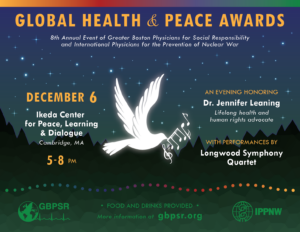
Greater Boston Physicians for Social Responsibility (GBPSR) and IPPNW hosted our 8th annual Global Health and Peace Awards on December 6th, 2025, honoring Dr. Jennifer Leaning, who has dedicated her life to health and human rights.
The event took place this year at the Ikeda Center in Harvard Square where we gathered for some beautiful music, food and drink, and socializing with friends and colleagues who share our concern about the twin existential threats of nuclear war and climate change.
IPPNW Virtual Student Congress
On 30 January and 13 February, the IPPNW Medical Student Movement held the first IPPNW Virtual Student Congress where over 60 students from more than 20 countries discussed nuclear disarmament, medical student activism, and how the country chapters can support each others.
Watch former International Student Representatives (ISRs), Franca Bruggen and Kelvin Kibet’s update on student activities and much more on our website now.
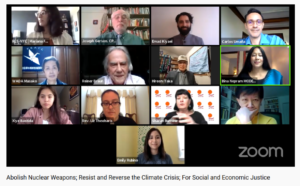
Online World Conference 2020: Abolish Nuclear Weapons, Resist and Reverse Climate Change, For Social and Economic Justice
The two hour long event connected the issues of nuclear weapons, the climate crisis, and social and economic justice in the context of the COVID-19 pandemic. IPPNW’s very own Dr. Carlos Umaña, Regional Vice President for Latin America, was the first speaker of the event, highlighting the humanitarian consequences of nuclear weapons and how this crisis connects with COVID-19. Additional speakers ranged from Xiye Bastida (Fridays for Future, Mexico) to United Nations High Representative for Disarmament Affairs Izumi Nakamitsu.
IPPNW Students #BikefortheBan
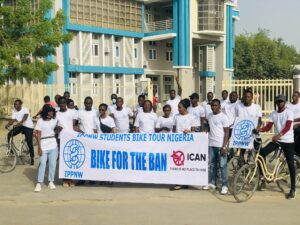
The weekend of 18 February, dozens of medical students in six countries — Germany, Kenya, Nepal, Nigeria, Russia, and Zambia — carried IPPNW’s mission to their local communities via regional bike tours. Despite the physical distance between the chapters, all were brought together with one unifying message: the abolition of nuclear weapons is a public health imperative. Learn more.
World Conference: Youth Assembly
The event was moderated by the co-chairs of the Planning Committee, Molly McGinty, Program Associate at IPPNW and Emily Rubino, Director of Policy and Outreach at Peace Action New York State. Seven main panelists were featured, touching on different aspects of nuclear abolition, climate change, social and racial justice. Among the panelists were Franca Bruggen and Kelvin Kibet, IPPNW Medical Student Representatives, who spoke to the medical aspect of COVID-19 and how that is impacting the world around us, tying this back to the threat of nuclear weapons.
IPPNW World Congresses
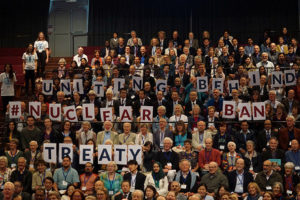
Congresses are important opportunities for health professionals, medical students, and activists to share information and strategies related to the abolition of nuclear weapons and the prevention of armed violence.
Collaboration with the Middle East Treaty Organization (METO)
On the 20th of August, 2020, IPPNW and METO held a joint webinar targeted at stimulating disarmament initiatives from within the Middle East titled, “Building the movement of health workers to prevent a humanitarian catastrophe involving nuclear weapons”. The idea was inspired by the work of the original founders of IPPNW, Soviet and US physicians, who were among the first to recognize the catastrophic consequences of nuclear weapons on human health and the dangers they pose to human civilization and even the very survival of human beings as a species.