![]() | |||||||||||
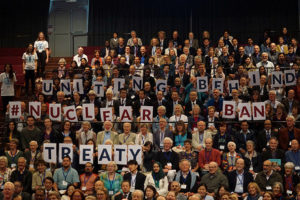
World Congresses also help fulfill the organizations mandate to present new research through the scientific program; to educate members of the international medical community about our work to abolish nuclear weapons and prevent war through lectures and workshops; and to advocate for changes in government policies that advance our mission through meetings with political leaders and journalists. A press conference on June 27 was well attended by Paris journalists and activists and resulted in articles on IPPNWs work in two major newspapers Le Monde and La Figaro. A major issue of concern and discussion throughout the Congress was US plans to build a national missile defense (NMD). IPPNWs Russian affiliate brought a message to IPPNW from Russian President Vladimir Putin that stated, . . . the current situation of which the international community is increasingly aware is the following. Either we will be able to save and enhance by joint effort everything we achieved in non-proliferation and reduction of nuclear weapons, or the entire system of the international and bilateral agreements developed in the past years in this field will be threatened. Particularly important will be the outcome of the debate over the ABM Treaty triggered by the US intention to create a national missile defense.
The Congress program officially began with the opening plenary on June 30. Featured speakers included: M. Michel Rocard, former Prime Minister of France; M. Cointe, Representative of the French Minister of the Environment; Marie-Therese Hermange, Deputy Mayor of Paris; Dr. Eric Hoskins, Senior Policy Advisor to Lloyd Axworthy, Canadian Minister of Foreign Affairs; Peter Weiss of the International Association of Lawyers Against Nuclear Arms; and Mai Britt Theorin, President of the International Peace Bureau. As soon as the plenary broke, an energetic group of IPPNW medical students wearing white coats and No Nukes face paint and bearing banners with Non aux armes nucleaire! led a demonstration through the streets of Paris (see article below). They handed out leaflets describing the medical consequences of a one-megaton nuclear bomb dropped on Paris -- five million Parisians would be instantly killed and millions more would suffer from blast, burn, and radiation injuries -- and informed passersby of IPPNWs work to abolish nuclear weapons. Delegates attended workshops on June 30 and July 1 led by experts on issues relevant to IPPNWs major programs, including the health and environmental effects of nuclear weapons production, testing, and use; new nuclear devices; the threat of accidental nuclear war and the campaign to de-alert nuclear weapons; new steps toward nuclear abolition; landmines, small arms, and the physicians responsibility; and war prevention. Working groups also met over these two days to discuss nuclear abolition, war prevention, and communications strategies.
Two special events commemorated the 20th anniversary of the founding of IPPNW and the 15th anniversary of the award of the Nobel Peace Prize. IPPNWs Founding Co-President Dr. Evgueni Chazov of Russia was the keynote speaker at the opening reception. Delegates later gathered at the Saint Francois-Xavier church for a Bach concert sponsored by the Albert Schweitzer Fellowship. Throughout the Congress, bonds between physician-activists were strengthened as they shared the tribulations and triumphs of work in their countries and regions of the world. Doctors from the North learned directly from their colleagues in the South about the enormous challenges and obstacles they face in their work to promote health through peace. Many partnerships between affiliates will develop from the dialogue that began. The Declaration of Paris, issued at the end of the Congress, speaks to the spirit and purpose of IPPNW: Here in Paris, we have found mutual encouragement and renewed strength -- we will continue to build a world in peace.
Congress Working Groups Energize International ProgramsThe most valuable part of an IPPNW World Congress, many participants have said, is the opportunity it provides for people to strategize together about the goals and directions of the federation's international programs. This brainstorming process was jumpstarted in Paris with the convening of working groups on nuclear abolition, the prevention of war, and effective media communications. While each working group was asked to prepare recommendations that could guide program work over the next year or two, the challenges faced by each were remarkably different, with the result that each report had a different scope and flavor. Nuclear Abolition: Beyond the NPTThe Nuclear Abolition Working Group, led by IPPNWs former Program Director and its new UN Office Director in New York Merav Datan, drafted a detailed outline of a two-year plan for building on the strengths of the Rx Abolition campaign. The group recommended that IPPNW continue to use its position and influence as a physicians organization to educate the medical community, policy makers, and the public about the health and environmental consequences of nuclear weapons production, testing, and use.
Medical education about the health effects of exposure to radiation was identified as a top priority, to be addressed through a review of the most current research, publication of new books, articles, and fact sheets for physicians and activists, and revision and more effective use of the medical curriculum and briefing kits. The group enthusiastically endorsed the Dialogue with Decision Makers program and recommended that IPPNW leaders continue to engage political and governmental leaders in consultations about the importance of eliminating nuclear weapons. The work of the Middle Powers Initiative, hosted at the IPPNW Central Office, was recognized as crucial to the abolition movement. With Merav Datan on her way to New York, the group placed special emphasis on promoting the Nuclear Weapons Convention (NWC) and building good working relations with government representatives to the UN. The enhanced IPPNW presence at the UN will also give affiliates increased access to delegates and policy information.
To advocate abolition responsibly, the group suggested, attention should be given to the health and environmental challenges of abolition. Support for the NWC should be accompanied by research into the risks of handling, transporting, and storing nuclear materials from disarmed and dismantled weapons. Preventing War: A Broader Physician VisionIPPNW's International Council, meeting at the 11th Congress in Mexico City in 1993, expanded our mission statement to include the mandate to "seek to prevent all wars, to promote non-violent conflict resolution, and to minimize the effects of war and preparations for war on health, development, and the environment."
In the seven years since that declaration was made, many IPPNW affiliates have broadened the scope of their work to address the actual consequences of violent conflicts in their regions, in addition to the potential catastrophic effects of nuclear war. At the Federation level, the Landmines Campaign and a new campaign around the medical consequences of the proliferation of small arms have emerged as major contributions to a more general war prevention strategy. Led by Drs. Ulrich Gottstein of Germany and Victor Sidel of the US, the Working Group on the Prevention of War plotted out a comprehensive and ambitious vision of a world in which conflict would be resolved non-violently, through institutions based on international law and respect for human rights and social justice. Preventing war, the group concluded, is a prerequisite for preventing nuclear war.
The final Congress report issued by the group was a stirring manifesto echoing the Hague Agenda for Peace and Justice. Among the recommendations of the working group on war prevention were the establishment of a professional mediation service at the disposal of the UN Secretary General and Security Council; the establishment in all governments of departments for war prevention; regional security organizations with strengthened peace-keeping capabilities; a strengthened International Criminal Court to prosecute war crimes, genocide, and other crimes against humanity; prohibition of arms exports and profits from wars; and a shift in investments from weapons production and wars to support for human needs. Six smaller working groups will continue to explore these ideas, in an effort to develop practical, effective actions that can be taken by IPPNW members.
Communications: Defining the MessageIn a world where thousands of groups with hundreds of thousands of messages are competing for the attention of the media and the public, crafting an effective message and connecting with a potentially responsive audience is an ongoing challenge. At the invitation of Co-President Dr. Mary-Wynne Ashford, Suzanne Hawkes of the non-profit media center IMPACS led Communications Working Group members through a fast-paced, tightly focused series of exercises designed to help define an effective media strategy. At the recommendation of the Working Group, a small number of IPPNW leaders will meet with Hawkes again later this year at a two-day retreat to develop a formal communications strategy around IPPNWs nuclear abolition message and our work to achieve a Nuclear Weapons Convention -- a treaty that will ban nuclear weapons. Medical Student Congress
This year's Medical Student Congress, held on 28-29 June in Paris (two days prior to IPPNW's XIVth World Congress), was an overwhelming success, leaving everyone who attended it with a feeling of optimism and enthusiasm about the future of IPPNW's student movement. The Student Congress brought together 80 students from 22 countries, including Australia, Canada, Denmark, Finland, France, Germany, Japan, Mexico, the Netherlands, Norway, Philippines, Sweden, the UK, and the US, as well as Greece, Kenya, Poland, Romania, Russia, Turkey, Yugoslavia, and Zambia -- countries that have not been adequately represented in past Student Congresses. IPPNW is grateful to the numerous IPPNW affiliates that extended financial support to students -- particularly those from developing countries -- to attend the Paris Congress.
The program of the Student Congress featured addresses on the history of IPPNW and the role of medical students and health professionals in the struggle for peace by IPPNW Co-President Dr. Mary-Wynne Ashford and former IPPNW Co-President Dr. Victor Sidel. Workshops on Children & War, led by Dr. Joanna Santa Barbara and Dr. Stanislas Tomkiewicz; Peace Education & Human Rights in the Medical Curricula, led by Dutch students; and MedEx (international medical student exchange program), generated a lot of enthusiasm. Participants held extended discussions on the future of IPPNW's medical student movement and engaged in a number of social activities that fostered a sense of unity and cohesion within the student body. On June 29th, the students organized a street action/demonstration in front of the St. Germain-de-Pres Church in the center of the Quartier Latin. Equipped with banners calling for the abolition of nuclear weapons and dressed in their white coats, students stood alongside IPPNW physicians, chanting abolition slogans and handing out flyers to passing Parisians.
The two new Medical Student Representatives to the IPPNW Board elected for 2000-2002 are Caecilie Buhmann from Denmark and Ernest Guevarra from the Philippines. Their goal is, in close coordination with the Central Office and in partnership with the International Federation of Medical Student Assocations, to steer students -- those who gathered together in Paris and all those who could not make it -- into a new era of IPPNW student activity. The Paris Congress was an important beginning. Now the students must work hard to follow through on its success and generate even more student activity throughout the world. Other Congress Materials:
|