IN THIS SECTION
Abolition of Nuclear Weapons
- Physicians and Nuclear War
- Catastrophic Humanitarian Consequences of Nuclear Weapons
- International Campaign to Abolish Nuclear Weapons
- Resources
Recipient of the Nobel Peace Prize. Learn more >>
IPPNW World CongressesIPPNW affiliates regularly participate in IPPNW's International World Congresses, most recently in Basel in 2010, New Delhi in 2008, Helsinki in 2006 and in Beijing in 2004.
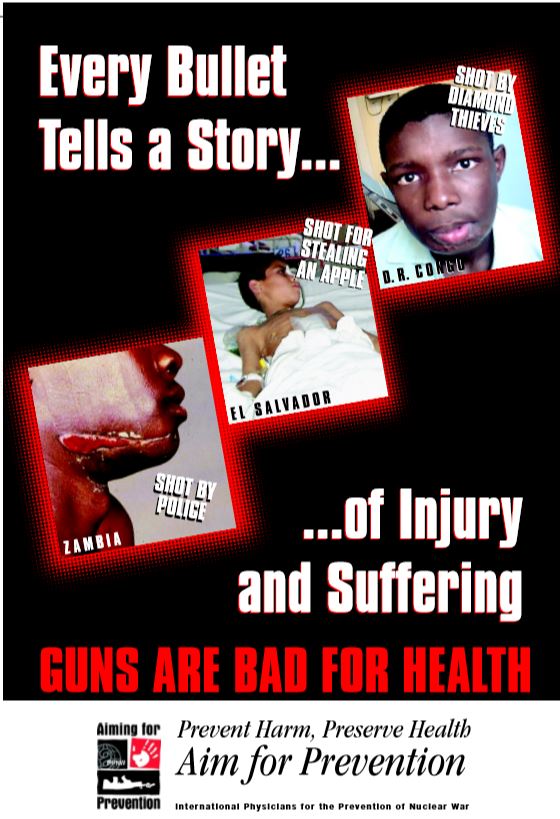
Aiming for Prevention (AfP) activists gathered in Basel, Switzerland to develop strategies for building global awareness of the public health dimensions of armed violence. Please go to the 2010 Congress website to view/download relevant presentations.
In particular, AfP researchers and activists explored ways to engage with the Geneva Declaration on Armed Violence and Development, which calls for measuring and monitoring injuries and deaths from gun violence and for the creation of “practical programmes on the ground, where the difference is made in terms of lives and livelihoods.” Translating clinical and other public health data into health-promoting policy initiatives is one of the key objectives of this IPPNW program in the year ahead.
A plenary session, four workshops, and several student congress sessions were devoted to AfP and armed violence prevention. The plenary, “Preventing Violence, Promoting Health and Development: A Medical and Moral Imperative,” featured a short film, Faces of Violence, conceived and produced by Igarapé and the Small Arms Survey with assistance from the Norwegian Ministry of Foreign Affairs for the Geneva Declaration on Armed Violence process. Ms. Kidist Bartolomeos of the World Health Organization’s (WHO) Department of Violence and Injury Prevention outlined the need for medical community involvement as a key civil society player in armed violence prevention. She reviewed the global burden of violence, including the stark reality that 91% of violent deaths occur in low-middle-income countries. She noted that violence obstructs achievement of the Millennium Development Goals and that an evidence-based public health approach is needed to prevent all types of violence. Ms. Bartolomeos called for intersectoral approaches and noted that engaging the health sector is one of the “10 best buys” in reducing the consequences of violence. IPPNW is an active member of the WHO Violence Prevention Alliance.
IPPNW affiliate physicians from around the world made a series of brief presentations about violence prevention work in Mexico, Zambia, New Zealand, Nepal, the UK, Ecuador, and Nigeria. Their dramatic photographs and commentaries underscored the humanitarian dimensions of armed violence and its consequences on victims, families, and societies. Other IPPNW projects, such as injury research in Papua New Guinea and Zambia, peace education via independent radio in Nigeria, and education about the horrors of armed conflicts in the Middle East, Mexico, and Nepal were also summarized. Dr. Sebastian Taylor of Action on Armed Violence (AOAV) highlighted the goals of the Geneva Declaration, a diplomatic initiative aimed at addressing the interrelations between armed violence and development, and how IPPNW members can participate.
Dr. Bernard Lown, one of the founding co-presidents of IPPNW, addressed the Congress from his home in Newton, Massachusetts, via the internet-based teleconference program Skype. Dr. Lown spoke about the continuing economic and social disparities between the global North and the global South and the implications for social justice, armed conflict, and the abolition of nuclear weapons:
“The North/South divide is mammoth and growing. According to the UN Human Development Report in 1960 the income gap between the richest and the poorest was 30-1; by 1999 it had more than doubled to 74-1. The just released Oxford Multidimensional Index of Poverty finds that 1,659 million [people] in developing countries live in acute poverty, of whom 840 million are continuously hungry…. The divide between the North and South is maintained, nurtured and made cancerous also by the arms trade. This has become a substantial source of developing world debt which limits poor countries investing in education, in health care, in clean water, in sanitation and in critical infrastructures. Tanzania, for example, spends four times more on debt repayment than on education and nine times more than on health.”
In his call to action to IPPNW in the coming years, Dr. Lown identified this as the first of three key areas in which we need to focus. “It is not possible,” he said, “for affluent nations to purchase security when wretched and hungry multitudes are clamoring outside the gates of the big house. Terrorism is not to be defeated by projecting military mayhem largely against civilians.”
Other plenary speakers throughout the Congress issued calls to action to medical professionals, including the ICRC’s Christine Beerlie, who said that “the use of [conventional] weapons is, and must continue to be, a public health issue,” calling them “weapons of mass destruction in slow motion.”
A series of four AfP workshops explored the Geneva Declaration; North/South affiliate cooperation; IPPNW’s participation and leadership in global initiatives related to landmines, small arms, and cluster munitions; the development of additional case studies and One Bullet Stories; and possibilities for additional injury surveillance projects.
Following a series of consultations with representatives from other organizations, including the WHO’s Department of Injuries and Violence Prevention, and AOAV, AfP activists established several working groups to plan for the coming year’s efforts to advance a public health approach to violence prevention at the international and regional levels.