logo

Environmental Security and Public Health:
Steps Toward a New Theoretical Framework

Tee L. Guidotti, MD, MPH, John M. Balbus, MD, MPH

The connections among ecosystem viability, sustainability, and state or civil security have been a minor theme of the modern environmental movement since its inception. Only within the past decade, however, has the idea of environmental security become an organizing principle of the academic study of international relations [1]. Recent wars, the effects of unrestrained economic globalization, and concerns about population growth, scarcity of resources, and global warming have given the concept an immediacy and relevance it previously lacked. As a result of some carefully focused research and analysis over the past several years, the concept of environmental security can now be generalized beyond individual cases to provide a useful theoretical framework for analyzing issues and anticipating events [2-7].

The evolving definition of environmental security has two broad themes: 1) the response to strategic military assaults on public health and the environment, and 2) security issues associated with environmental disruption. The oilfield fires in Kuwait at the end of the Gulf War; the destruction of military and industrial facilities and of natural ecosystems during conflicts in the former Yugoslavia, Chechnya, and elsewhere; and fears of bioterrorism have prompted renewed interest in a concept of environmental security that brings operational issues of environmental health together with issues of state security and sustainability, national defense, civil unrest, and terrorism. The groundwork has been laid for a much more rigorous and thoughtful approach to these issues, and a modern field of “environmental security” is emerging that encompasses:

  1. destruction of public health and the environment as a military strategy;
  2. the effects of “environmental warfare” on combatants and non-combatants alike; and
  3. threats to national and international security posed by severe environmental degradation.

Waging Environmental War

Aggressive destruction of the environment during war is at least as old as the seeding of the farmlands of Carthage with salt by the victorious Romans. During the Cold War, the risk of global nuclear devastation, including the prospect of nuclear winter, was the subject of a large and well-documented public and professional literature [8-12]. The tactical use of chemical and biological weapons of mass destruction to threaten public health has received increasing scrutiny in recent years [13,14].

Strategic defensive ecological destruction--a second way in which the environment is targeted during war--can be traced back at least as far as the scorched earth policies of ancient retreating armies, and through World War II and beyond. At the end of the Gulf War, we were reminded that outlaw regimes may be prepared to wage a military endgame by intentionally destroying their own environment and resources, and those of their adversaries, once they have nothing to lose.

Chemical and biological weapons are accessible, easily concealed, and cheap, and are therefore highly attractive to hard-pressed or marginalized states and to terrorists. They embody the aggressive use of environmentally hazardous toxins and are a particularly sinister use of the biomedical sciences. Since control of these weapons is dispersed, and disseminating them globally is relatively easy, the tactics required to deal with them must be very different from the measures that reduced the threat of nuclear annihilation [15].

An examination of bioterrorism, in particular, illuminates crucial features of the overall emerging concept of environmental security. The relationship between public health agencies and the military and police is particularly important and has the potential to be troublesome. The FBI and--if the threat comes from outside the country--military agencies have a mandate to take the lead role after a bioterrorist attack in the US. It can hardly be otherwise. Public health agencies will not be able to control the security aspects of such operations, but they will have a role thrust upon them that will be simultaneously indispensable and uncomfortable. Despite the fact that the norms of public health clearly provide for constraining individual behavior during a public health crisis, public health agencies have been understandably reluctant to exercise their statutory policing powers in the modern era. Open discussion among all the stakeholders in government, the health professions, and civil society is essential before the first such event occurs.

Combatantand Non-Combatant Casualties

Gulf War Illness, health effects associated with Agent Orange, and other health problems presented by combatants in recent wars may or may not be direct outcomes of particular environmental exposures. Nevertheless, as the weapons and military technologies employed on battlefields become increasingly exotic, and as the ecological dimensions of war widen, health concerns related to environmental exposures can only take on new urgency, not only for combatants, but for noncombatant civilians, refugees, and observers. As with Gulf War veterans, the challenge of sorting out the effects on combatants and on the traumatized noncombatant population will be in part exposure assessment and in part population profiling, because persons who have such a traumatic life experience are not easily comparable to other populations. Environmental degradation and risks to health among noncombatant workers in military production facilities--especially at nuclear weapons testing and production sites--must not be overlooked [16,17].

War is about intentional destruction, and also involves collateral damage to the environment, even if not intended. Ecological management of the distressed environment is a fundamental step to recovery after the shooting stops and the immediate task becomes rebuilding the economy and civil life. Widespread ecological destruction left behind after the Vietnam and Persian Gulf wars and after numerous other conflicts in Central America, the former Yugoslavia, Africa, and elsewhere underscore the point that while such damage may eventually be managed and overcome, it can result in prolonged consequences for health, nutrition, public safety, and security [18].

Environmental Origins of Conflict

Connections between the natural environment and national security have long been recognized but are incompletely documented [19]. The notion has nevertheless entered mainstream thinking that environmental stresses, including population pressure and conflict over resources, may lead to military conflict between states or may destabilize societies and lead to civil conflict.

The connection between national security interests and access to resources, particularly strategic resources such as oil, is self evident. Population control advocates have been particularly disposed to put demography forward as a fundamental reason for civil and interstate conflict, but they have tended to ignore technological changes that have affected the magnitude of human impact on the environment.

Conflicts over water are likely to become more frequent and more contentious during the present century [20]. At least 48 countries are expected to face severe water shortages by the year 2025 [21]. Eroding water quality, due to pollution or saline intrusion associated with sea level rise, will compound regional problems of water scarcity, especially under conditions of global climate change. Water scarcity in areas fed by the Jordan, Nile, Tigris-Euphrates, and Ganges River systems, historical focal points of conflict over water resources, could exacerbate regional conflicts and pose new threats to international security.

Ecosystem degradation on a massive scale, such as may be associated with global climate change, could conceivably precipitate interstate and civil unrest. The actual evidence that environmental degradation--as opposed to the need to secure resources--has been a major reason for war, however, is weak. Recent archeological findings suggest that theories linking the decline of some civilizations with the depletion of resources are incomplete, though they have captured the popular imagination. It is not clear that population pressures and environmental degradation lead directly and necessarily to armed conflict. What is clear is that scarcity of necessary resources and a large population burden add to other political and social pressures that may lead to or exacerbate conflict. Far more study of the relationship between global environmental stresses and the causes of conflict is essential.

The Need for a Coordinated Approach

To understand the entire range of environmental security issues requires coordinated research and development. The needs include:

  • robust and specific methods of surveillance that can function in the absence of a modern public health infrastructure;
  • “dual use” systems that are cost-effective in normal times and that provide needed public health services between the major events they were designed to handle;
  • forensic methods that can be incorporated into public health practice;
  • advance planning and operational coordination between public health agencies and military and civilian security agencies;
  • prevention, through the application of the same approaches that have proven effective against other public health threats;
  • education, both to “harden” the target and to ensure that public health agencies are capable of coordinating their efforts with security and military services without compromising the essential values of public health.

At the turn of the twentieth century, public health research was often oriented toward maintaining colonial rule and military occupation in tropical regions. Some visions of “environmental security” have tilted toward racism and tribalism, offering persistent, negative images of penurious, foreign immigrants swarming into affluent societies in the US and Europe and overwhelming their civilizations. As we enter a new millennium, the emerging theory and practice of environmental security is far more positive, based on technical assessments of imminent threats and on management of the response for the public good. Environmental security, as presently understood, has the potential to add new and valuable dimensions to the public health enterprise.

This vision of environmental security proposes areas of study that will lead to a more secure society--one that has the confidence to protect its environment and to maintain its commitment to sustainable development. A siege mentality, in the face of real and pervasive security threats, would displace environmental sustainability as a political and social priority and would obstruct the progress we can make. A proper concern for real problems, and the development of appropriate responses, can ensure that environmental security threats do not overwhelm us and distort our decision making, as the balance of nuclear terror so often did.

References

1. Porter G. Post-Cold War environment and security. Fletcher World Forum 1990;14(2):332-344. [Return to text]
2. Westing AH. Weapons of mass destruction and the environment. London: Taylor & Francis. 1977. [Return to text]
3. Westing AH. Warfare in a fragile world: Military impact on the human environment. London: Taylor & Francis. 1980. [Return to text]
4. Westing AH (ed). Environmental hazards of war: Releasing dangerous forces in an industrialized world. Oslo: International Peace Research Institute. 1990. [Return to text]
5. Homer-Dixon TF, Boutwell JH, Rathjens GW. Environmental change and violent conflict. SciAm Feb. 1993: 38-45. [Return to text]
6. Leaning J. War and the environment: Human health consequences of the environmental damage of war. In: Chivian E, McCally M, Hu H, Haines A. Critical condition: Human health and the environment. Cambridge, Mass: MIT Press. 1993. [Return to text]
7. Levy BS, Shahi GS, Lee C. The environmental consequences of war. In: Levy BS, Sidel VW. War and Public Health. New York, Oxford: Oxford University Press. 1997. [Return to text]
8. Piemonte T. Nuclear winter. Lancet 1988;2:785-786. [Return to text]
9. Pittock AB, Ackerman TP, Crutzen PJ, et al. Environmental consequences of nuclear war. SCOPE 28 Vol. 1, Physical and atmospheric effects. Chichester: John Wiley & Sons. 1985. [Return to text]
10. Harwell MA, Hutchinson TC et al. Environmental consequences of nuclear war. SCOPE 28 Vol. II, Ecological and agricultural effects. Chichester: John Wiley & Sons. 1985. [Return to text]
11. Glasstone S, Dolan P. The effects of nuclear weapons. Washington, DC: U.S. Department of Defense and U.S. Energy Research and Development Administration. 1977. [Return to text]
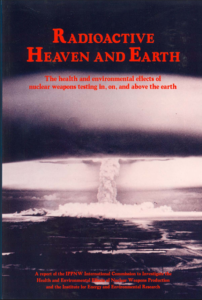
12. International Physicians for the Prevention of Nuclear War. Radioactive heaven and earth. New York: Apex Press. 1991. [Return to text]
13. Guidotti TL. Bioterrorism and the public health response. Am J Prev Med 2000;18:178-180. [Return to text]
14. Franz DR, Jahrling PB, Friedlander AM, McClain DJ, Hoover DL, Byrne WR, et al. Clinical recognition and management of patients exposed to biological warfare agents. JAMA 1997;278:399-411. [Return to text]
15. Committee on R&D Needs for Improving Civilian Medical Response to Chemical and Biological Terrorism Incidents, Health Science Policy Program, Institute of Medicine; and Board on Environmental Studies and Toxicology, National Research Council Chemical and Biological Terrorism: Research and Development to Improve Civilian Medical Response. Washington DC, National Academy Press, 1999. [Return to text]
16. Physicians for Social Responsibility. Dead reckoning: A critical review of the Department of Energy’s epidemiologic research. Washington, DC: PSR. 1992. [Return to text]
17. Makhijani A, Hu H, Yih K. Nuclear wastelands: A global guide to nuclear weapons production and its health and environmental effects. Cambridge, MA: MIT Press. 1995. [Return to text]
18. Levy BS, Sidel VW. War and Public Health. New York, Oxford: Oxford University Press. 1997. [Return to text]
19. Litfin KT. Constructing environmental security and ecological interdependence. Global Governance (Academic Council for the United Nations), July-September 1999;5(3):359-377. [Return to text]
20. Postel S, Aldinger C. “World Facing Water Crisis in 21st Century,”, Reuters, March 19, 1996. [Return to text]
21. Hinrichsen D, Robey B, Upadhyay UD. Solutions for a water short world. Baltimore, MD: Johns Hopkins School of Public Health. 1998. [Return to text]

TLG and JMB are on the faculty of the Department of Environmental and Occupational Health, School of Public Health and Health Services, The George Washington University Medical Center, Washington, DC USA. Address correspondence to Tee L. Guidotti, MD, Department of Environmental and Occupational Health, School of Public Health and Health Services, George Washington University Medical Center, Washington, DC USA 20037; e-mail: eohtlg@mail.gwumc.edu.

Copyright © Medicine & Global Survival, Inc. 2000


Sidebar

Environmental Security at GWU

The George Washington University Medical Center (GWUMC) has adopted environmental security as one of its designated departmental themes for emphasis in education and research. The field is seen as conceptually integrated, but in practice it remains a response to a loosely connected set of issues.

Bioterrorism was the issue that first consolidated the Center’s institutional thinking on environmental security, reflecting GWUMC’s unenviable position as the single health care provider in the United States most likely to serve a population that has experienced a chemical or bioterrorist attack.


Would you like to comment on this article?

Please use this form to submit brief comments to the editors of M&GS. Or send a longer commentary by e-mail. Comments will be considered for publication only if they are signed by the author and an e-mail address is provided for validation purposes.

Your Name:

Your e-mail address:

Your thoughts about this article
(Please insert cursor after article title):


Return to M&GS homepage

Return to IPPNW homepage