
 |
Aiming
for Prevention:
International Medical Conference on Small Arms, Gun Violence
and Injury Helsinki, Finland, September 30, 2001A Medical Call to
Action to Reduce Small Arms Deaths and InjuriesMedical
and social scientists, peace activists, research workers, non-governmental organizations,
and government representatives from many parts of the world have gathered in Helsinki
to address the threat to human health posed by the widespread use of small arms.
This initiative has occurred in the shadow of recent sudden violence that has
shocked the entire world, but we recognize that the continued injury and loss
that daily attends the deliberate or indiscriminate use of small arms is no less
shocking to the affected individuals and their families. The level of small arms
violence is enormous and the scale of human suffering it causes is immense though
poorly counted, but causes at least hundreds of thousands of deaths and more than
one million injuries each year, as well as permanent physical and psychological
damage, the destruction of families, lost productivity, and the diversion of resources
from basic health services. Physicians are challenged by
the immediate needs of victims and by the long and costly physical and psychological
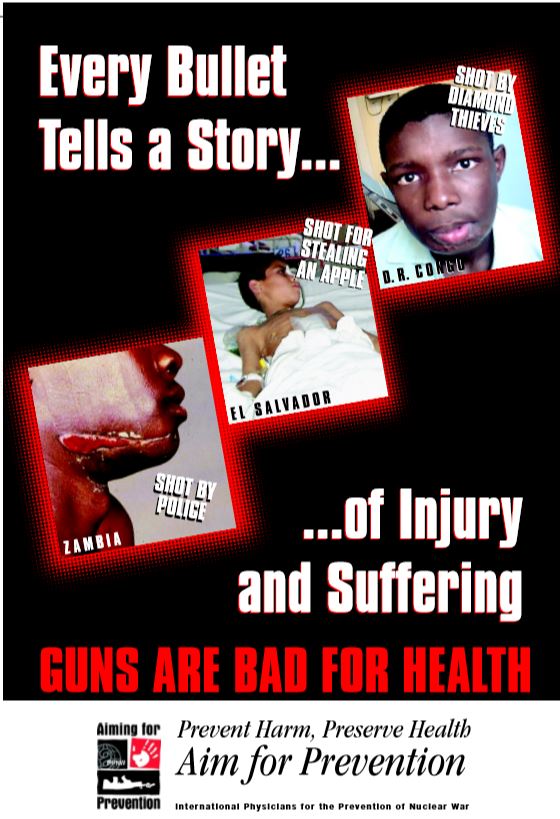
rehabilitation needed by so many. We are called to describe the grim reality of
mutilation and loss so that the human victim, rather than the bullet or the gun,
is seen clearly as central to the issue. We emphasize the phenomenon of small
arms and gun violence as not primarily a law enforcement problem or a national
security problem but as, in essence, a global health crisis of the utmost urgency.
We further recognize a continuum of violent conflict, from homicide and criminal
violence to intrastate wars up to and including nuclear war that are all linked
by the ways in which people justify meeting violence with violence. Physicians
concerned to reduce the carnage from small arms violence can contribute to strategies
for prevention, but this also requires a very wide range of expertise. The causes
of small arms and gun violence are legion, and therefore preventive strategies
need to involve a wide range of disciplines, many of which have been represented
here in Helsinki. Participants have come to a common understanding of the complexities
of a problem that manifests itself differently from place to place, and a recognition
of the need to maintain a coalition of active scientific concern. IPPNW's
approach to the prevention of violent conflict at every level has been grounded
in elements of research, education, and advocacy, and these are directly relevant
to the violence that employs small arms. From Helsinki,
we call on health professionals in particular, but also on the many other scientists,
activists, humanitarian and development workers who can contribute to an effective
confrontation of the small arms pandemic, to: - Collect and report accurate
and relevant data on which to base recommendations for policy change and community
action.
- Join in a comprehensive educational campaign to inform our professions,
our students, and the public about the multiple causes and the devastating consequences
of small arms violence.
- Contribute their heightened awareness of the public
health and social consequences of small arms to local, national, and international
dialogue, so that effective policies to reduce the levels of human injury resulting
from the escalating presence and use of small arms in every part of the world
can be implemented as soon as possible.
As physicians
we view the problem of small arms in terms of their impact, taking into account
the full burden of human suffering -- injury, disability, and death -- that results
from their use. We commit ourselves to work in close cooperation with health and
humanitarian partners, both to limit the availability of small arms and to promote
non-violent paths to human safety and security. Helsinki Conference Links:
|  |