IPPNW Medical Student ActivistsWe
cannot rest on the laurels of the many significant achievements of IPPNW when
40,000 children die daily from remediable causes, when nearly a billion people
will enter the 21st century unable to read a road sign, when hundreds of millions
are homeless and without the most elementary needs for decent subsistence.
"There can be no peace without
justice. Our work is far from done. It is with you, our future leaders, that the
fate of humanity rests. Bernard
Lown, MD, IPPNW Co-Founder
As the next generation of health professionals, IPPNW
medical students are already playing an active role in safeguarding the planets
health. Working with IPPNW affiliated organizations
throughout the world, medical students show by example what can be achieved through
international cooperation, and they provide a powerful voice in the global movement
to promote peace and justice for all. IPPNW medical students
work on many projects to promote peace, disarmament, and human rights.
Work to Prevent Nuclear War:
Because nuclear weapons remain the greatest immediate threat to human survival,
IPPNW students help educate fellow students and the public about nuclear weapons
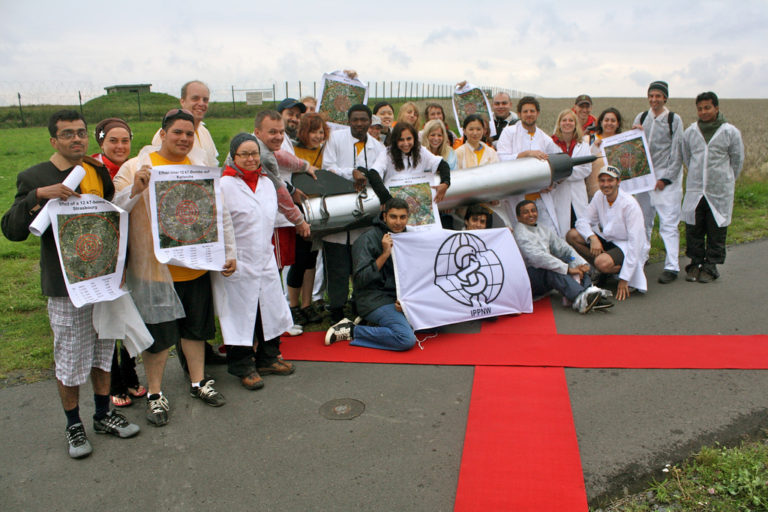
and the consequences of nuclear warfare. Exhibitions and lectures are the most
common tools, but street actions such as Target X
have also proven effective. Peace
Education: IPPNW students are currently working to establish a peace education
program for school children where medical students teach tolerance and peaceful
solutions to conflict to younger generations. Human
Rights in the Medical Curricula: In a number of countries, students and doctors
join their efforts to get human rights education accepted as an integral part
of the medical curriculum. Refugee
Work: IPPNW students have developed projects to help refugees in Chiapas,
Zambia, the Netherlands, Germany, Philippines and Yugoslavia, among others, to
address their needs and to provide them with assistance. Children
and War: Since 1993, students have been developing projects under the theme
"Children & War" in Chiapas, Philippines, US, Bosnia and Slovenia. These projects
aim at promoting health and counseling children, the most innocent and vulnerable
victims of war. Environment:
In Egypt and the US, students have initiated education and advocacy activities
on environmental issues such as medical waste and Persistent Organic Pollutants
(POPs). Workshops:
Students have organized human rights workshops in the Netherlands, Germany and
the Philippines, a workshop on refugees in Finland, landmines workshops in Norway,
and workshops in Romania and the UK on nuclear weapons, among others.
Exchange Programs: IPPNW
has set up an international medical student exchange program (MedEx), based on
a successful program in Germany, where students perform a clinical rotation and
also follow an active IPPNW doctor in his/her IPPNW-related work. In Germany,
a training and social activity exchange program combines clinical work and work
on socially responsible projects. IPPNW also has programs for students active
in the organization's work, where they can visit each other, learn from the experiences
of others, and take part in national projects. Network
and Communication: In order to maintain communication, medical students hold
annual regional meetings where students from the same part of the world meet and
evaluate projects, exchange experiences and make plans for the future. Once every
second year students gather at the IPPNW World Congress. Close to a hundred
students from all seven IPPNW regions met in Bejing in September of 2004
for the 16th World Congress. The Congress is not only an opportunity for students
to meet each other, but also a chance to meet socially responsible doctors. More
information about the IPPNW student movement can be found on the medical
student website!
|