
Excerpts from the Acceptance Speeches
The
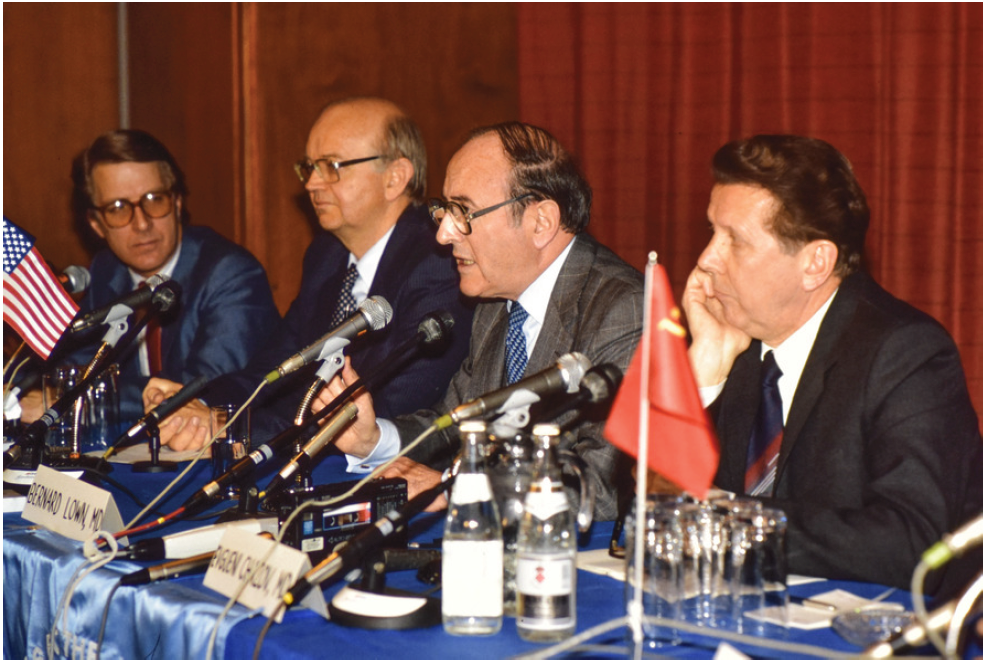
following is the acceptance speech delivered by Dr. Bernard Lown on the occasion
of the awarding of the 1985 Nobel Peace Prize on 10 December 1985.
Your Majesty, Your Royal Highness, Mr. Chairman, Colleagues in the International
Physicians for the Prevention of Nuclear War, Friends, Distinguished Ladies and
Gentlemen. Dr. Chazov and I are filled with deep emotions
of gratitude, of humility and of pride as we accept this most prestigious prize
on behalf of our movement. We are both cardiologists and usually speak about the
heart. Today we speak from the heart. If we are to succeed in our goal of ridding
military arsenals of instruments of genocide, we need the extraordinary energizing
strength that comes when mind and heart are joined to serve humankind.
We physicians who shepherd human life from birth to death have a moral imperative
to resist with all our being the drift toward the brink. The threatened inhabitants
on this fragile planet must speak out for those yet unborn for prosperity has
no lobby with politicians. The official announcement of
the Nobel Committee on October 11th commended IPPNW for performing "a considerable
service to mankind by spreading authoritative information and by creating an awareness
of the catastrophic consequences of atomic warfare." The statement continued,
"this in turn contributes to an increase in the pressure of the public opposition
to the proliferation of nuclear weapons." This distinguished
award honors physicians of our movement, who are responsible for such noteworthy
accomplishments. It empowers the 135,000 members worldwide with a new elan and
determination to prevent what cannot be cured. The new-found inspiration is demonstrated
by the presence here in Oslo of 300 members, many of whom have traveled from halfway
around the world from faraway Australia, Latin America, Bangladesh, India, and
Japan, representing 38 of our 41 national affiliates. The enormous prestige of
the Nobel Prize provides a unique opportunity for further mobilizing and educating
a still larger public. Thus the reasons for awarding the prize will be enhanced
by receiving the prize. The Committee's citation took
note of the "awakening of public opinion," and the thought was expressed that
this new force can "give the present arms limitation negotiations new perspective
and a new seriousness." Much has transpired since to provide reason for guarded
optimism. At the meeting in Geneva three weeks ago, the leaders of the two great
powers affirmed their determination to prevent nuclear war. They have expanded
Soviet-American exchanges to promote a wide-ranging dialogue essential to foster
understanding and to build trust. Cooperation on any scale is far preferable to
relentless confrontation. Summits like those in Geneva
promote hope. But hope without action is hopeless. Our enthusiasm for the positive
spirit in these deliberations must not blind us to the absence of genuine progress
towards disarmament. Twenty-four nuclear bombs are being added weekly to the world
arsenals. We physicians protest the outrage of holding
the entire world hostage. We protest the moral obscenity that each of us is being
continually targeted for extinction. We protest the ongoing increase in overkill.
We protest the expansion of the arms race to space. We protest the diversion of
scarce resources from aching human needs. Dialogue without deeds brings the calamity
ever closer, as snail-paced diplomacy is out-distanced by missile-propelled technology.
We physicians demand deeds which will lead to the abolition of all nuclear weaponry.
We recognize that before abolition can become a reality, the nuclear arms race
must be halted. At our Fourth Congress in Helsinki 18 months ago, I urged a policy
of reciprocating initiatives, the process propelled by popular understanding and
public pressure. As its first medical prescription the IPPNW endorsed the cessation
of all nuclear testing. Our analysis leads to the inescapable conclusion that
nuclear testing has a central role in the development of new, more sophisticated
and more destabilizing weapons. From this world podium
we call upon the governments of the United States and the Soviet Union to agree
to an immediate mutual moratorium on all nuclear explosions to remain in effect
until a comprehensive test ban treaty is concluded. A moratorium is verifiable,
free of risk to either party, simple in concept yet substantive, has wide public
support, and is conducive to even more dramatic breakthroughs. On November 21st
an overwhelming majority of members of the United Nations favored amending the
Limited Test Ban Treaty to make it comprehensive. If enacted, a moratorium will
begin unwinding the potential doomsday process. We physicians
have focused on the nuclear threat as the singular issue of our era. We are not
indifferent to other human rights and hard-won civil liberties. But first we must
be able to bequeath to our children the most fundamental of all rights, which
preconditions all others: the right to survival. Alfred
Nobel believed that the destructiveness of dynamite would put an end to war. He
deeply believed that the tragic reality of mass carnage would achieve results
which all the preachments of peace and goodwill had so far failed to achieve.
His prophecy must now gain fulfillment. Recoiling from the abyss of nuclear extermination,
the human family will finally abandon war. May we learn from the barbaric and
bloody deeds of the 20th century and bestow the gift of peace to the next millennium.
Perhaps in that way we shall redeem some measure of respect from generations yet
to come. Having achieved peace, in the sonorous phrase of Martin Luther King spoken
here twenty-one years ago, human beings will then "rise to the majestic heights
of moral maturity."
The
following is the acceptance speech delivered by Dr. Eugueni Chazov on the occasion
of the awarding of the 1985 Nobel Peace Prize on 10 December, 1985.
Ladies and Gentleman, Dear Colleagues, I am convinced that today is a great and
exciting day not only for the members of our international movement but also for
all physicians on our planet, irrespective of their political and religious beliefs.
For the first time in history, their selfless service for the cause of maintaining
life on Earth is marked by the high Nobel Prize. True to the Hippocratic Oath,
we cannot keep silent knowing what final epidemic-nuclear war- can bring to humankind.
The bell of Hiroshima rings in our hearts not as a funeral knell, but as an alarm
bell calling out to actions to protect life on our planet.
We were among the first to demolish the nuclear illusions that existed and to
unveil the true face of nuclear weapons- the weapons of genocide. We warned the
peoples and governments that medicine would be helpless to offer even minimal
relief to the hundreds of millions of victims of nuclear war.
However, our contacts with patients inspire our faith in the human reason. Peoples
are heedful of the voice of physicians who warn them of the danger and recommend
the means of prevention. From the first days of our movement we suggested a prescription
for survival which envisaged a ban on tests of nuclear weapons, a freeze, a reduction
and eventual elimination of nuclear weapons, non-first-use of nuclear weapons,
ending the arms race on Earth and preventing it from spreading to outer space,
creation of the atmosphere of trust between peoples and countries, and promotion
of close international cooperation. Let us recall the
words of French author A. de Saint-Exupery who said, "Why should we hate each
other? We are all in one, sharing the same planet, a crew of the same ship. It
is good when dispute between different civilizations gives birth to something
new and mature, but it is outrageous when they devour each other."
Confrontation is the road to war, destruction and end of civilization. Even today
it deprives the world's peoples of hundreds of millions of dollars which are badly
needed for solving social problems, combating hunger and diseases.
Cooperation is the road to increased well-being of peoples and flourishing life.
Medicine knows many examples when joint efforts to nations and scientists contributed
to successful combat against diseases such, for example, as smallpox.
The five years of International Physicians for the Prevention of Nuclear War were
not all roses. We had to cope with mistrust, skepticism, indifference and sometimes
animosity. Our aspirations are pure: from time immemorial the physician was and
remains the one who dedicated his life to the happiness of fellow men. And we
are happy that today the broad public and, what is especially important for the
cause of peace, the Nobel Committee show high appreciation of the noble and human
endeavor of each of the 145 thousand physicians persistent in the work to prevent
nuclear war. For this we are grateful to the Committee.
The award of the Nobel Peace prize to our movement invigorates all the forces
calling for the eradication of nuclear weapons from Earth. We are thankful for
to numerous public, political, state and religious figures all over the world
for their support of our movement and our ideas. It was physically impossible
to reply in writing to everyone; therefore, I use this opportunity to express
my sincere gratitude to all who have sent their warm congratulations.
At this moment, I recall the telegram I received at the time of our first Congress
from an ordinary woman in Brooklyn. It was short: "Thank you on behalf of the
children." As adults we are obliged to avert transformation
of the Earth from a flourishing planet into a heap of smoking ruins. Our duty
is to hand it over to our successors in a better state than it was inherited by
us. Therefore, it is not for fame, but for the happiness and for the future of
all mothers and children that we- the International Physicians for the Prevention
of Nuclear War- have worked, are working and will work. |